
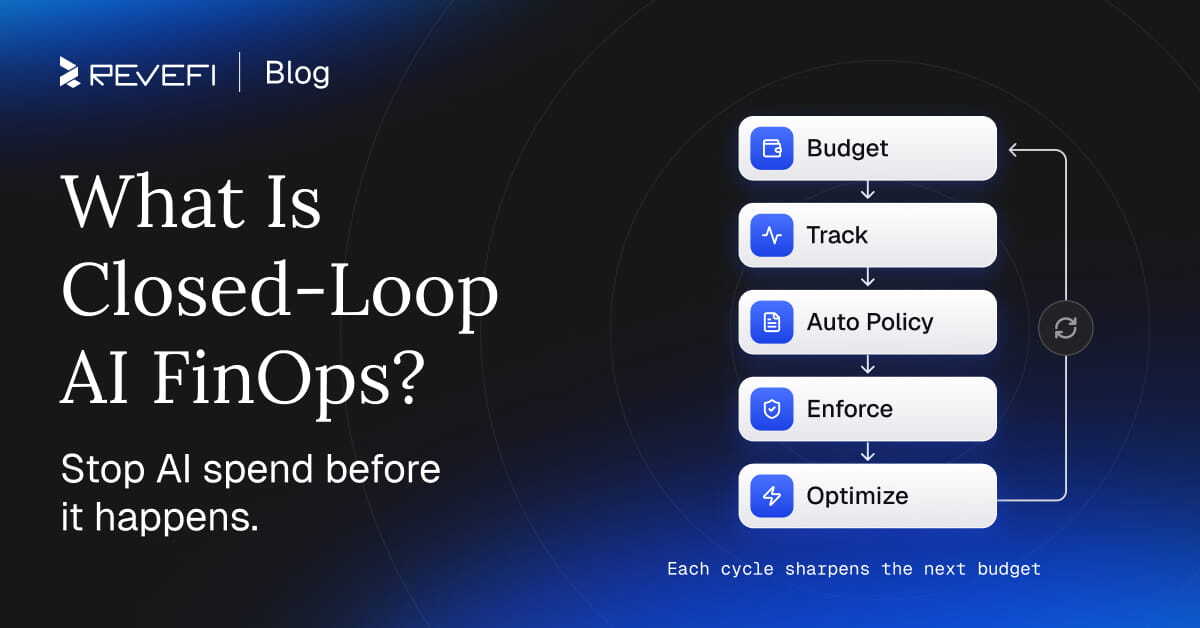
Closed-Loop AI FinOps is the practice of enforcing the budget a business sets on the AI activity that consumes it, while that activity runs. Instead of reporting spend after the bill arrives, it stops overspend before it happens.
It joins five steps into one cycle: budget, track, create policy, enforce and optimize. What each cycle learns shapes the next budget. The idea is simple. Getting there means connecting systems most enterprises run separately today.
AI Spend Moves Faster Than the Bill
AI costs don't behave like cloud infrastructure costs. Pricing is per token. Usage is driven by people and agents, not provisioned capacity. And agents run around the clock.
A single change can move spend by an order of magnitude. One agent stuck in a loop, one prompt that doubles its context, or one switch to a larger model can multiply token costs overnight.
Traditional FinOps runs on a monthly cadence: review the bill, find the waste, adjust. For AI, the bill arrives after the damage. At one Fortune 500 enterprise, a single user ran up $76,000 in unexpected token spend on one AI use case. Revefi caught it within minutes. Without that signal, and a way to act on it, it would have surfaced on the invoice.
Dashboards See. Gateways Act. Neither Closes the Loop.
Most enterprises already have some of the pieces. Each covers part of the problem.
FinOps dashboards report spend by team, model and provider, but only after the money is gone. AI gateways route and rate-limit traffic, but they don't know whose budget a request draws from. Manual policies try to bridge the gap, and drift out of date as soon as usage changes.
An open loop either sees without acting or acts without context. A closed loop joins the two: budgets set the policy, and the policy acts on live traffic.
How Closed-Loop AI FinOps Works
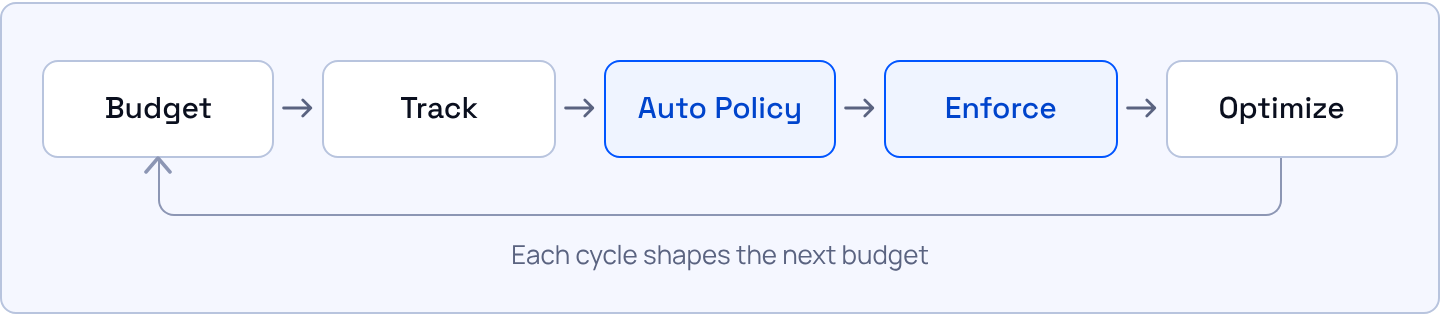
- Budget. Set hard or soft budgets by business unit, cost center, team, application, agent, model or provider. Forecasts show which budgets will overrun, and when.
- Track. Trace every request from user to agent to model, with token cost, latency and outcome at each step. Spend maps to the owners finance already tracks.
- Create policy. Revefi's Auto Policy analyzes historical and live usage, then turns budgets into guardrails: spend thresholds, model routing rules and limits for each workload. No one writes rules by hand.
- Enforce. Policies act at runtime. Alert, require approval, downgrade the model, rate-limit or stop. Agent loops and spikes get caught as they start.
- Optimize. Prompt and token optimization and model routing cut spend inside each budget, so teams stay under caps without cutting usage.
Then the loop repeats. Actual spend, enforcement events and optimization results feed the next budget, and Auto Policy tunes the guardrails as usage shifts.
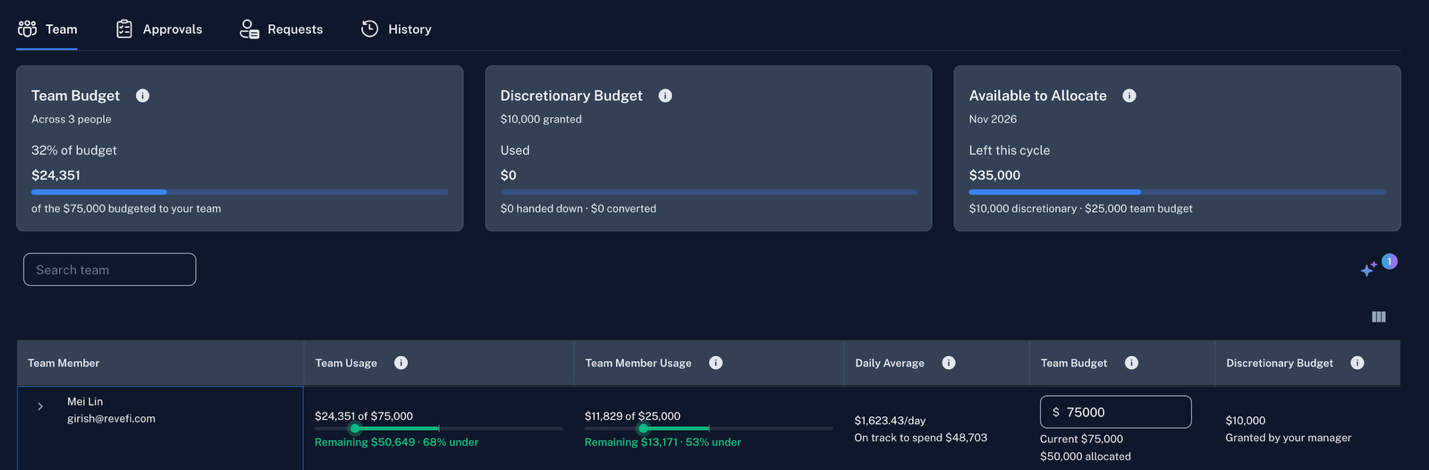
Enforcement Needs a Control Point
A budget only binds if something sits in the request path. That control point is an AI gateway.
With Revefi, enforcement runs through the Revefi AI Gateway or a gateway you already operate. Revefi supplies the budgets, attribution and policies. The gateway executes them. One policy spans OpenAI, Anthropic, Google and other model providers.
Visibility doesn't wait for the gateway. Connecting AI providers is zero-touch and read-only, with value in as little as five minutes. Enforcement switches on when a gateway is connected.
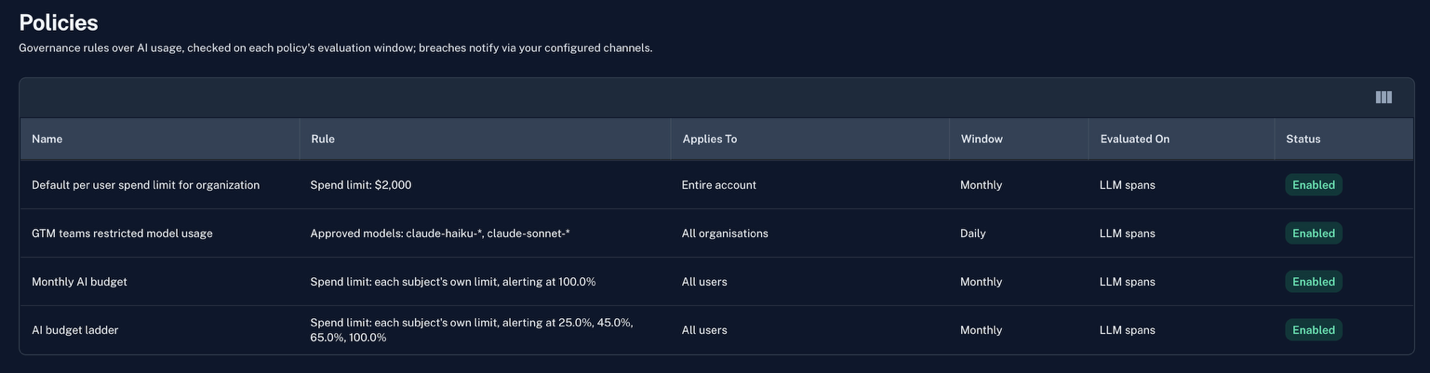
What It Looks Like at Scale
A Fortune 200 enterprise saw AI spend grow 8x in under four months, across more than 25,000 users, 200 million requests a month and 10,000 AI services. At that scale, a monthly review can't keep up.
Revefi identified seven-figure savings within three weeks. Closing the loop is how savings like that hold as usage keeps growing, instead of leaking back one new agent at a time.
Get Started
See how Revefi runs Closed-Loop AI FinOps on the AI FinOps & Observability page, or request an AI FinOps Assessment.