
Enterprise AI has evolved beyond models and GPUs. A modern AI application is a distributed system: models, agents, tools, APIs, enterprise data, identity services, security controls, and operational telemetry, all interacting on every request. As that system grows, organizations need well-defined control points at the boundaries between components, and those control points are increasingly implemented as gateways.
What Is a Gateway for Enterprise AI?
An AI infrastructure gateway is an intermediary layer that sits in the request path and manages communication between AI applications and the models, agents, tools, APIs, and data sources they use.
Gateways do not perform inference themselves. Their role is to create a controlled boundary where organizations can apply routing, authentication, authorization, policy, security, observability, reliability, and cost-management capabilities consistently, regardless of which application or agent originates the request.
Does Enterprise AI Need Multiple Control Points?
A single AI request may cross several systems. A user asks a copilot a question; the copilot calls an LLM, retrieves documents, queries a warehouse, invokes an enterprise application, and requests approval before taking an action. Each boundary has different operational and risk requirements: the model boundary needs cost and failover controls, the tool boundary needs permissions and auditing, the data boundary needs masking and query governance.
One gateway rarely covers every responsibility well. Enterprises therefore tend toward a layered strategy: specialized gateways control individual boundaries, while horizontal layers provide identity, security context, telemetry, and governance across the stack. The goal is not to maximize the number of gateways; it is to establish clear control points without redundant policy layers, inconsistent telemetry, or unnecessary latency.
The Test That Sorts the Market
An AI infrastructure gateway is an intermediary that sits in the request path between AI applications and the models, agents, tools, APIs, and data sources they use. It does not perform inference; it creates a controlled boundary where routing, authentication, policy, security, and cost management are applied consistently.
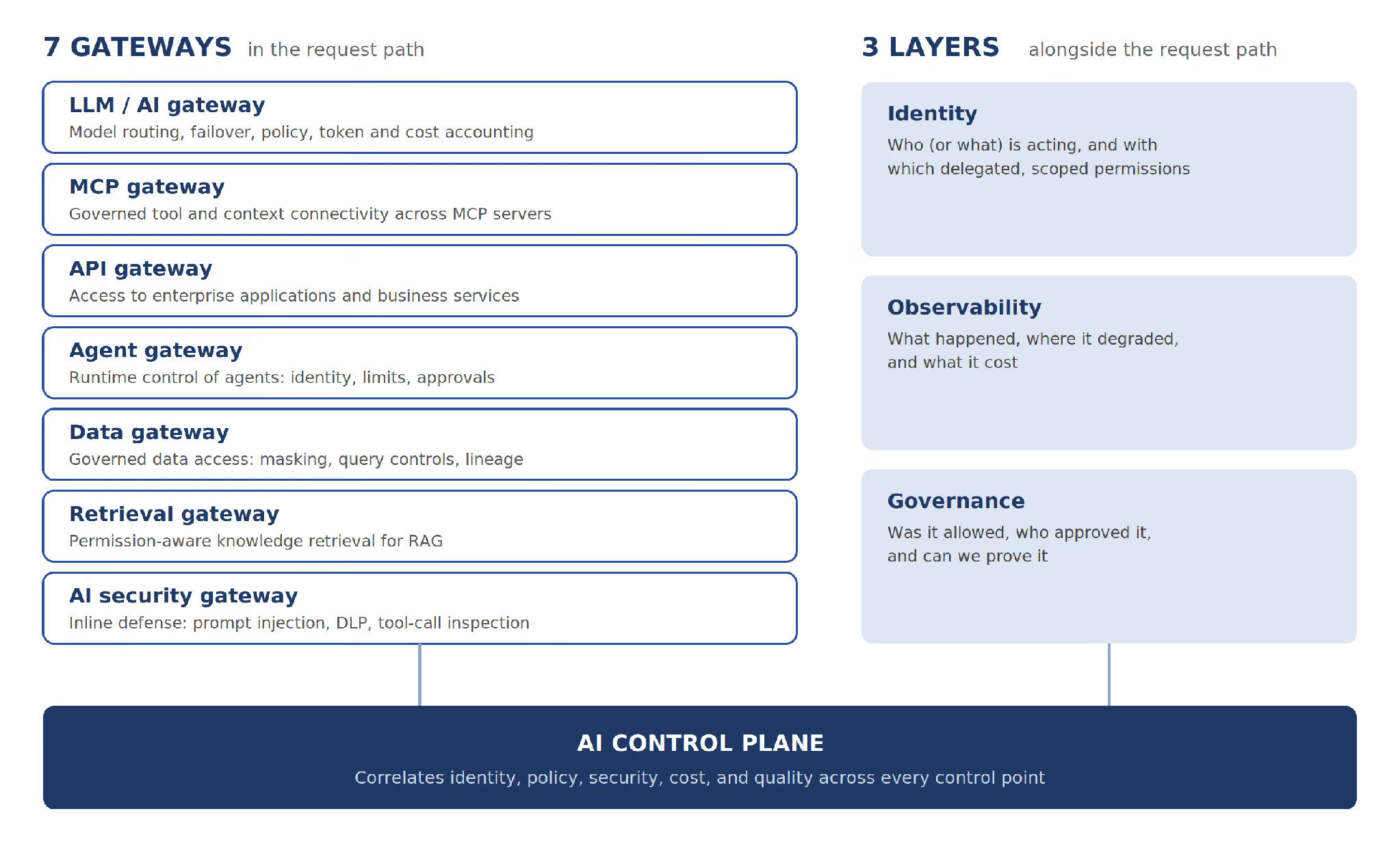
The "in the request path" test matters because plenty of essential AI infrastructure, including observability platforms, governance catalogs, and identity providers, operates alongside the request flow rather than proxying it. Those are layers, not gateways. They are no less important; they are a different architectural shape, and buying one while expecting the other is a common procurement mistake.
The 7 Gateways
- LLM / AI gateway. Unified, policy-controlled access to models: routing, failover, caching, token and cost accounting. The market once split "LLM gateway" from "AI gateway"; the terms have converged. (Portkey, LiteLLM, Kong, Cloudflare, Helicone, OpenRouter, TrueFoundry)
- MCP gateway. Governed tool and context connectivity across Model Context Protocol servers. An MCP server provides capability; the gateway provides control over how it is discovered and used. (Cloudflare, Obot, IBM ContextForge, Lasso, agentgateway)
- API gateway. Not AI-specific, but agents’ most consequential calls, the ones that touch CRM, ERP, and payments, still run through it. Usually the most mature piece of the stack, worth extending before buying anything new. (Kong, Apigee, MuleSoft, AWS, Azure)
- Agent gateway. Runtime control of agents as actors: identity, delegation, execution limits, approvals. Emerging, and distinct from agent frameworks like LangGraph or CrewAI, which build agents rather than govern their traffic. (agentgateway, Kong, Zuplo)
- Data gateway. Governed data access: masking, query controls, lineage. The policies that apply to humans must apply to agents, which never get tired of probing. (Starburst, Denodo, Immuta, Snowflake, Databricks Unity Catalog)
- Retrieval gateway. Permission-aware knowledge retrieval for RAG, so an agent cannot surface documents its principal could not open. Usually a pattern built with retrieval platforms rather than a boxed product. (LlamaIndex, Pinecone, Weaviate, Vectara)
- AI security gateway. Inline defense against prompt injection, jailbreaks, and data leakage, inspecting prompts, responses, and tool calls. Consolidating fast into the big security platforms. (Lakera/Check Point, Palo Alto Networks, HiddenLayer, Cisco)
The 3 Layers (Often Mislabeled as Gateways)
Identity determines who or what is acting and with which delegated, scoped permissions (Okta and Auth0 with Auth for GenAI, Microsoft Entra Agent ID, WorkOS). Observability captures traces, quality signals, and cost attribution from what the gateways emit (Langfuse, Arize, Braintrust, OpenTelemetry GenAI conventions). Governance preserves the evidence: audit trails, approvals, compliance reporting (Microsoft Purview, Collibra, Credo AI, IBM watsonx.governance). None of these proxy traffic. All of them make the gateways worth having.
The Gap Nobody’s Gateway Sees
Each gateway sees only its own boundary. The LLM gateway knows tokens and models; the MCP gateway knows tool calls; the data gateway knows queries. Nobody sees the workflow. That gap is driving interest in an AI control plane: a horizontal layer that correlates identity, policy, security, cost, and quality across all of the control points, and answers the questions no single gateway can. Which agent used which model and which data? What did the workflow cost, and was it justified by the outcome? Can we prove it complied with policy?
The Bottom Line
A mature Enterprise AI strategy does not search for one universal gateway, and it does not accumulate ten. It identifies the boundaries where control genuinely matters, places a control point at each, and connects them through shared identity, policy, telemetry, and economics.
For the complete framework, including the reference architecture and the boundary-mapping exercise, download the full ebook here.