
When artificial intelligence (AI) systems and solutions became part of an enterprise's mission-critical infrastructure, executive leadership ran into a jarring financial reality: AI costs do not behave like traditional software expenditures.
In legacy enterprise Software-as-a-Service (SaaS), costs scale linearly with user seats. In standard cloud infrastructure, costs scale with predictable compute hours and storage gigabytes. But in large language models (LLMs) and generative AI, financial performance hinges on an entirely new currency unit: the token.
Token economics, also called AI tokenomics, is the architectural discipline of gauging how tokens generate business outcomes through systematic metering, managing, attributing, and optimizing.
Unlike tokenomics in distributed ledger or cryptocurrency systems, which governs digital asset supply and incentive structures, AI token economics is an enterprise financial framework and an extension of cloud AI FinOps. In simpler terms, it governs the variable cost and compute efficiency of probabilistic intelligence.
What is AI token economics? Evaluating the atomic unit of AI and LLM value
A token can represent a single character, a sub-word component like "ing," or a complete common word, depending on the tokenization algorithm such as Byte-Pair Encoding (BPE).
This granular breakdown serves as the primary bridge between human linguistics and machine computing logic. Once split, each token maps to a specific numerical index inside the model’s core vocabulary matrix.
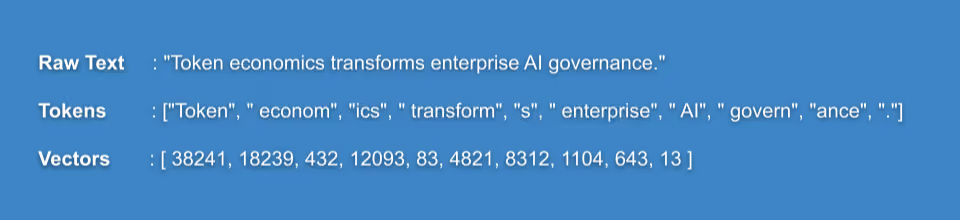
These numerical IDs convert into dense, high-dimensional vector embeddings that capture deep semantic relationships, contextual nuances, and linguistic patterns across localized regions.
Tokens directly define an AI architecture's computational memory limits, known as context windows. They also dictate enterprise operational costs, as API billing models scale globally based on token throughput. By standardizing diverse text into discrete numerical units, tokens allow transformer models to calculate probability distributions and reliably predict sequence outcomes.
Before going deeper into operational mechanics, it is worth addressing a major point of semantic confusion.
Anatomy of a token: how data converts into compute cost
Understanding the economics of AI requires understanding how unstructured human thought turns into machine-metered billable units.
The mechanics of tokenization
Tokenization relies on algorithms such as Byte-Pair Encoding (BPE) or WordPiece. These algorithms scan vast text datasets to build a dictionary of common sub-word sequences.
- A common word like "the" or "system" equals 1 token.
- An obscure or technical term, or a non-English word such as "unconstitutionality," might break down into 4 or 5 tokens ("un", "constitut", "ion", "al", "ity").
- Code syntax, special characters, spaces, and mathematical expressions often carry higher token density per sentence.
As a general rule of thumb in English prose:
Multimodal tokenization: images, audio, and video
Token economics extends far beyond text. Multimodal foundation models tokenize diverse media streams:
- Vision tokens:
Images are divided into fixed-size grid patches, for example 16x16 pixels. Each patch is mapped to a vision token. High-resolution images undergo spatial layout parsing, consuming hundreds or thousands of tokens per frame. - Audio tokens:
Continuous sound waves are sampled, passed through neural audio codecs, and discretized into time-slice acoustic tokens. - Video tokens:
Video streams compound cost rapidly, generating tokens across spatial frames and temporal motion dimensions simultaneously.
Five variables driving token consumption per request
A common failure mode for IT finance teams is assuming that one user query equals one API call of uniform cost. In reality, a single request sets off a cascade of hidden token amplification.
- System prompt overhead.
The standing instructions, safety constraints, persona rules, and structural guidelines appended to the system message before the user types a single word. These static instructions are re-sent with every API call, steadily eating into available context. To limit that drain, engineering teams often run system prompts through optimizer scripts to trim filler while maintaining strict rule adherence. - Context window and retrieval-augmented generation (RAG).
The retrieved documents, enterprise database vector matches, and prior conversational turns attached to provide domain context. RAG pipelines insert search snippets directly into the prompt payload, which inflates total token volume sharply. If dynamic vector search limits are set too loosely, irrelevant context clutters the window, raising compute costs and increasing hallucination risk. - Model selection and architecture.
The choice between a lightweight distilled model and a frontier reasoning model. Smaller sub-billion parameter models trade deep reasoning for low latency and cheap throughput. High-parameter reasoning models use internal chain-of-thought processing, which drives up both compute time and cost per token generated. - Output token length.
The length of the generated response, driven by model behavior, system instructions, and the user query. Output tokens carry a higher price than input tokens because of sequential processing bottlenecks. Uncapped max token parameters or loose formatting rules let models ramble, which turns into unexpected cloud spend. - Orchestration, retries, and tool definitions.
The JSON schema definitions of tools passed into every API call, combined with retry loops, parsing failures, and multi-agent coordination passes. Passing complex schema specifications forces the model to evaluate function signatures on every turn. If a tool output fails validation, automated orchestration loops re-execute the prompt sequence, silently multiplying context usage in the background.
Navigating elastic demand in agentic AI: the Jevons paradox
A central trend in AI pricing is that unit prices per million tokens fall over time as hardware accelerates and inference providers optimize system efficiency.
Falling unit prices do not translate into lower aggregate cloud spend. Instead, enterprises run into the Jevons paradox: as a resource becomes more efficient and cheaper per unit, overall consumption rises sharply.
When the average per-token cost drops:
- Engineering teams expand system context windows from 4,000 to 128,000 tokens and beyond.
- Single-turn chat applications get replaced by autonomous multi-agent orchestration systems that run 10 to 30 internal sub-queries per user task.
- Workloads shift from pure text to token-dense image and video processing pipelines.
Declining token prices make complex agentic workflows economically viable, and that viability is what drives aggregate volume growth.
Not all tokens are equal: goodput vs raw throughput
To manage token economics effectively, enterprise teams have to recognize that tokens are not homogeneous commodities. Treating a token generated by a background batch script the same as a real-time streaming token distorts both financial and operational analysis.
The governing metric for production inference is goodput, calculated as the percentage of total generated tokens that meet strict, task-specific service level objectives.
The four tiered regions of inference performance
- Bulk and batch tokens.
High throughput per megawatt, lower real-time speed. Ideal for offline data extraction, embeddings, and overnight summarization. These offer the lowest cost per token. - Balanced enterprise tokens (the Goldilocks zone).
Standard interactive speeds, roughly 30 to 80 tokens per second. Designed for enterprise portal queries, internal search, and interactive business software. - Ultra-low latency tokens.
High-frequency delivery above 100 tokens per second, or a very low time to first token. Critical for voice agents, real-time code autocomplete, and customer service tools. These carry a premium price because of dedicated compute allocation. - Reasoning tokens.
Models that perform a thinking phase before returning an answer generate internal reasoning tokens. They are invisible in the final conversational output, and they still consume substantial compute energy and are fully billed by model providers.
The complete AI cost stack around the token
Focusing solely on foundation model API invoices leads to an incomplete picture of total cost. Token costs sit within a broader ecosystem of enterprise infrastructure expenses.
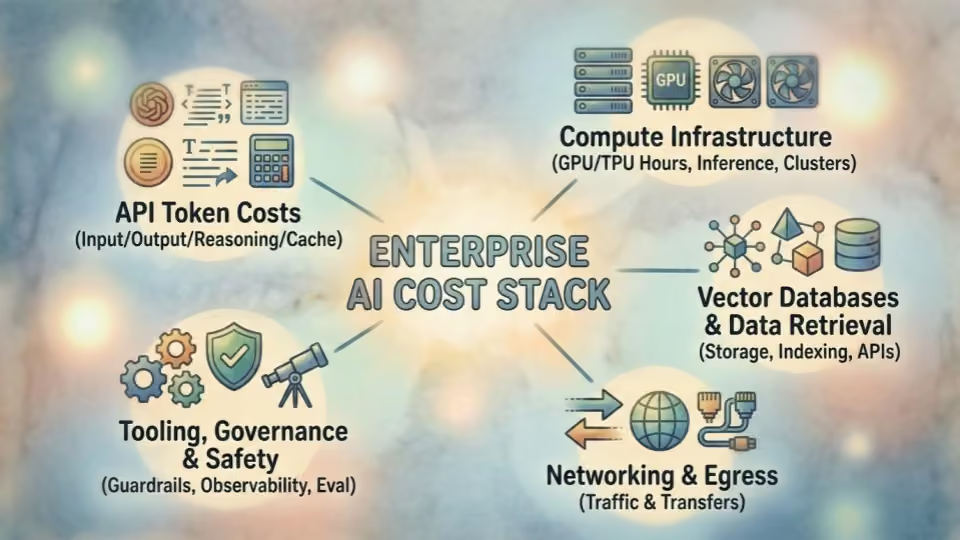
The layers of AI financial governance are:
- Foundation model inference.
Raw per-token pricing billed by external API vendors or internal GPU clusters. Organizations face continuous variable expenses based on real-time token throughput, where input and output processing rates vary depending on model size, parameter count, and regional query volume. - Vector data infrastructure.
Dedicated compute and memory hosting vector embeddings for enterprise RAG workflows. Real-time semantic retrieval requires high-memory cloud instances and distributed vector indexing, which drives up infrastructure overhead as corporate knowledge bases scale and require updates across multi-tenant servers. - Network and cross-region egress.
Data transfers between private cloud environments, vector stores, and multi-cloud model endpoints. Moving high-volume payloads and large embedding sets across geographically distributed data centers introduces recurring bandwidth charges that compound during peak international hours. - Engineering, evaluation, and guardrails.
Latency monitoring, input and output sanitization filters, automated testing suites, and observability platforms. Operational reliability demands middleware to filter malicious prompt injections, run continuous regression checks, and track latency across production deployment layers. - Shadow AI expenses.
Unmonitored employee API key usage and unmanaged SaaS tools with buried AI upcharges. Decentralized purchases and rogue integrations create financial blind spots, inflating tech budgets through redundant subscriptions and unverified third-party processing platforms.
Unit metrics for strategic AI FinOps
To bring token economics down to business reality, leadership has to map technical token metrics directly to business outcomes.
How can organizations reduce AI and LLM token expenditure?
As generative AI expands into production copilots and multi-agent workflows, token expenditure has become a material variable operating cost. Gartner forecasts worldwide AI spending will breach US$2.59 trillion by the end of 2026, up 47% year over year, while AI-model spending will grow 110% to approximately $32.6 billion.
Those economics make LLM cost optimization, AI FinOps, and token observability essential to enterprise AI operations.
1. Cache reusable prompt context
Apply prompt caching to static system instructions, policy documents, large knowledge bases, few-shot examples, and tool schemas. Place stable content at the beginning of prompts and dynamic user data at the end to improve cache reuse. Track cache-hit rate, cached-token savings, storage costs, and prompt-version changes.
2. Route requests to the right model
Use an intelligent model-routing layer to classify requests by complexity, context length, latency, risk, and output-quality requirements. Smaller or specialized models can handle extraction, classification, tagging, and routine summarization, while frontier models stay reserved for complex reasoning and high-risk tasks.
3. Compress and retrieve context
Do not pass entire enterprise documents into every prompt. Use semantic chunking, deduplication, metadata filtering, hybrid retrieval, reranking, and context-budget enforcement to insert only relevant passages.
4. Enforce token and workflow limits
Set maximum input, output, reasoning, retry, tool-call, and cumulative workflow token limits. Require structured outputs such as JSON Schema to reduce conversational filler and simplify downstream validation. Agentic systems should also include recursion limits, no-progress detection, and circuit breakers that terminate runaway workflows before they generate excessive spend.
5. Use batch inference for non-urgent workloads
Move document indexing, bulk classification, translation, evaluations, and sentiment analysis to asynchronous batch queues, which providers price at a fraction of standard inference. Production implementations should include idempotency controls, checkpoints, dead-letter queues, retry policies, and job-level cost attribution.
6. Monitor token analytics
Track token consumption by provider, model, user, department, feature, prompt version, and agent. Monitor input and output tokens, cached tokens, latency, retries, errors, and completed business outcomes. Key AI FinOps metrics include cost per successful task, retry amplification, cache-hit rate, model-routing distribution, and tokens per completed agent workflow.
Sustainable token economics comes from combining caching, intelligent model routing, context compression, budget controls, batch processing, and real-time observability. The objective is not to minimize token usage, but to reduce quality-adjusted AI costs while preserving accuracy, reliability, and business value.
Mastering AI token economics with Revefi
Token economics is the cornerstone of effective enterprise AI governance. As models become more powerful and multi-agent systems handle increasingly complex tasks, tokens will remain the standard unit for metering machine intelligence.
Revefi bridges the gap between AI performance and financial governance by serving as a unified AI observability and AI FinOps control plane across multi-model and multi-provider workflows, including OpenAI, Anthropic, and Google Gemini. It converts unmanaged token sprawl into a fully attributable, cost-efficient, and audit-ready enterprise asset.
- End-to-end attribution.
Traces every request from user to agent to model, delivering granular spend tracking to the cent. - Cost and drift optimization.
Pinpoints spend outliers, eliminates redundant calls by improving cache hit rates, and fixes slow or expensive prompts. - Single-pane visibility.
Replaces fragmented vendor dashboards with real-time latency benchmarking, failure rate monitoring, and reliability tracking for agentic and generative AI workloads.
By understanding the factors that drive token consumption, evaluating tokens against performance and latency requirements, and putting proactive cost controls in place, organizations can scale AI capabilities efficiently while maximizing return on investment.