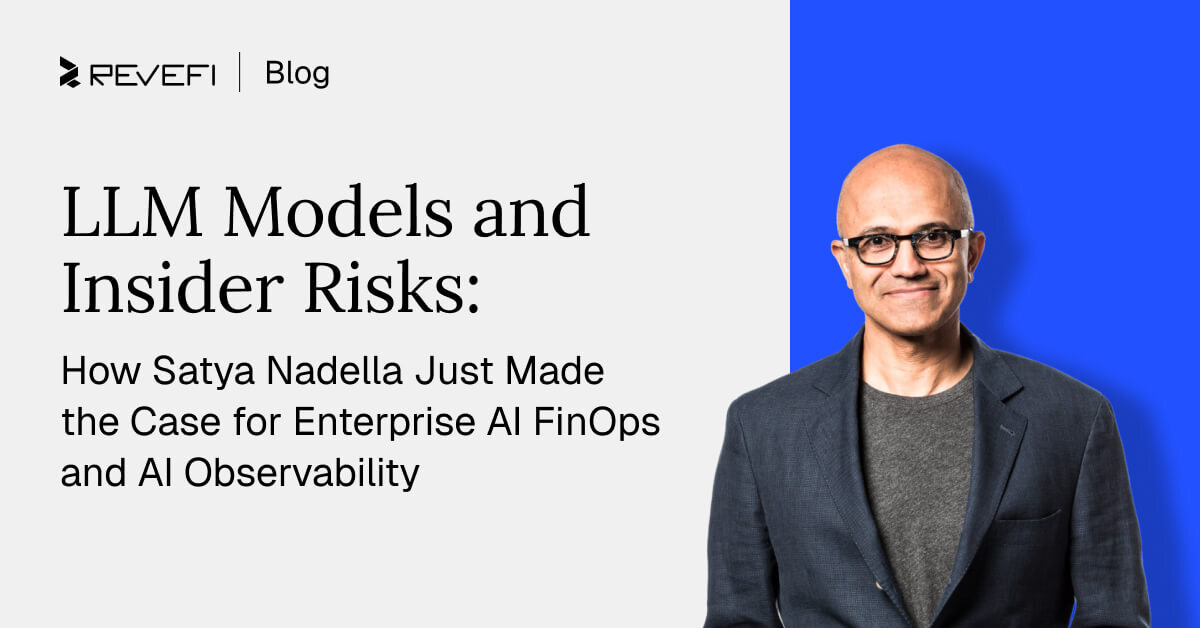
Satya Nadella (CEO, Microsoft) posted a short essay on the popular social media platform X last weekend arguing that enterprises should treat frontier models as insider risks.
Not as villains. As insiders or actors with real access to sensitive data and real authority to act. In short, your AI agents are like any of your other employees who can make mistakes or get compromised.
Most of the reaction has focused on the security framing. However, I see things a bit differently! When you carefully analyze the seven principles he lists, every one is an observability or observability related requirement.
Satya didn't just describe a trust architecture for AI. He described why AI observability has to exist, and what it has to do. And that's the problem we've been solving at Revefi.
For example, one of our F500 customers identified a financial risk due to accidental overrun of Snowflake Cortex (CoCo) use that resulted in significant resource waste and would have led to critical exposure if it was not dealt with.
Observability has to sit outside the model
With traditional software, we could trace a bad outcome back to a code path. With a frontier model, we cannot.
We can't tie an output to a slice of training data or a set of weights. So the evidence has to come from somewhere else.
Satya's recommendation is to put the controls outside the model. A model can't grade its own homework. A second model watching the first doesn't fix that if you can't see inside either one. You get what he calls “nested black boxes”, and a lot of what passes for AI governance today is exactly that.
The insider-risk analogy makes the point clearer. Security teams don't catch insiders by reading minds. They catch them through behavior. Like when the account suddenly pulls ten times its normal data volume, or the user logs in at 3 a.m. from a new country.
They watch what the insider does, from systems the insider doesn't control.

That's what observability is. Not the model's account of itself. An independent record of what it actually did, built from the systems it touched.
What AI Observability Must Cover
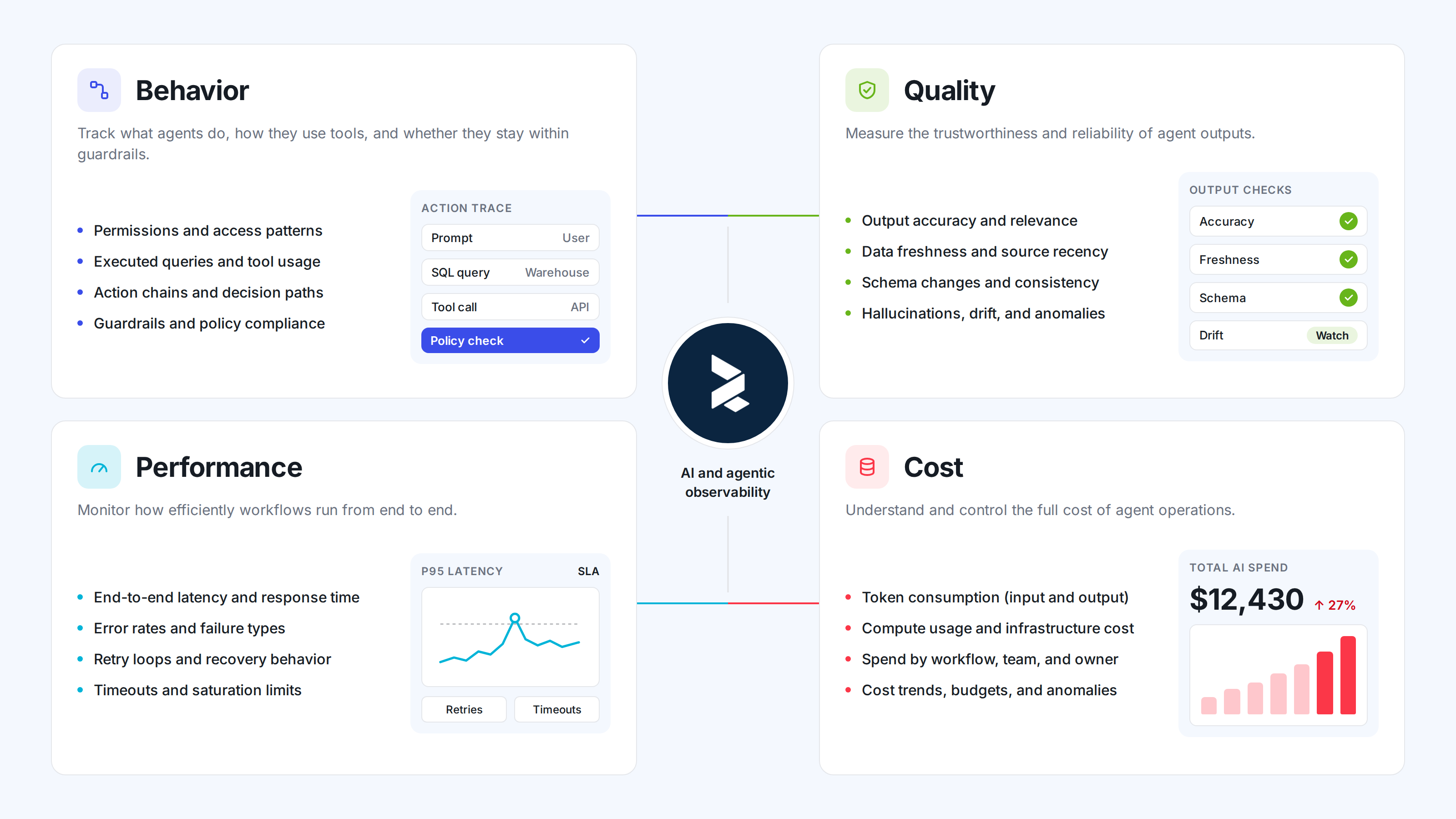
If observability serves as an independent system of record, the key question becomes what evidence it must capture. At Revefi, we believe a comprehensive framework requires coverage across two core layers and four critical signals.
The Two Layers: Model and Data
Artificial intelligence agents never operate in isolation. They call frontier foundation models while simultaneously executing queries, reading tables, and writing output across data platforms like Snowflake, Databricks, and Google BigQuery. Monitoring only the LLM misses half of the execution path. Monitoring only the underlying data warehouse obscures the underlying context. Effective oversight requires inspecting both.
The Four Essential Signals
- Behavior: Tracks agent permissions, executed queries, tool usage, and overall action chains to ensure operations align with intended guardrails.
- Quality: Evaluates whether model outputs and upstream data sources remain accurate, fresh, and consistent, flagging schema changes or data drift before issues cascade.
- Performance: Tracks end-to-end latency, error rates, retry loops, and timeout limits across both API requests and system query workloads.
- Cost: Measures token consumption by model, compute utilization on the cloud data platform, and total financial burn broken down by workflow, team, and owner.
Cost deserves to be mentioned here as a note, because it's often the first signal to move.
An agent stuck retrying a failed tool call burns tokens all night.
An agent with too much access runs unbounded scans.
A routing change quietly sends simple requests to a pricier model.
None of these trigger a security alert. All of them show up in spend. Billing and platform telemetry also have a useful property, which is that the model can't rewrite them!
This is the ground we've covered for years on data platforms, watching cost, performance and quality from outside the systems themselves. AI workloads run on top of those same platforms. Extending that independent view to the models and agents is the natural next step, and it's where Revefi is focused.
How Satya's Principles Can Be Mapped to Observability
Here's how each principle translates for a data or platform leader who wants to act this quarter, not next year.
The information in this table is sourced from Satya Nadella’s recent article on social platform X.
Trust the model the least. Observe it the most.
Satya closes with a line worth putting on a wall:
“The most trustworthy Super Intelligence system will not be the one with the model we trust most. It will be the one that enables us to trust the model the least.”
Here's the practical catch. You can only afford to trust a model if you can see more of what it does.
Distrust without visibility just means slower adoption. Distrust with visibility means you can deploy agents against real data and real workflows, because you'll know when something goes wrong and you'll have the evidence to fix it.
Observability is what turns principles from a manifesto into an operating model. Call the technology AI or call it SI. The supply of intelligence will keep getting cheaper and more capable.
The independent view of what it does is the part every enterprise has to own.
Sanjay Agrawal is co-founder and CEO of Revefi, the AI observability platform for data and AI teams.