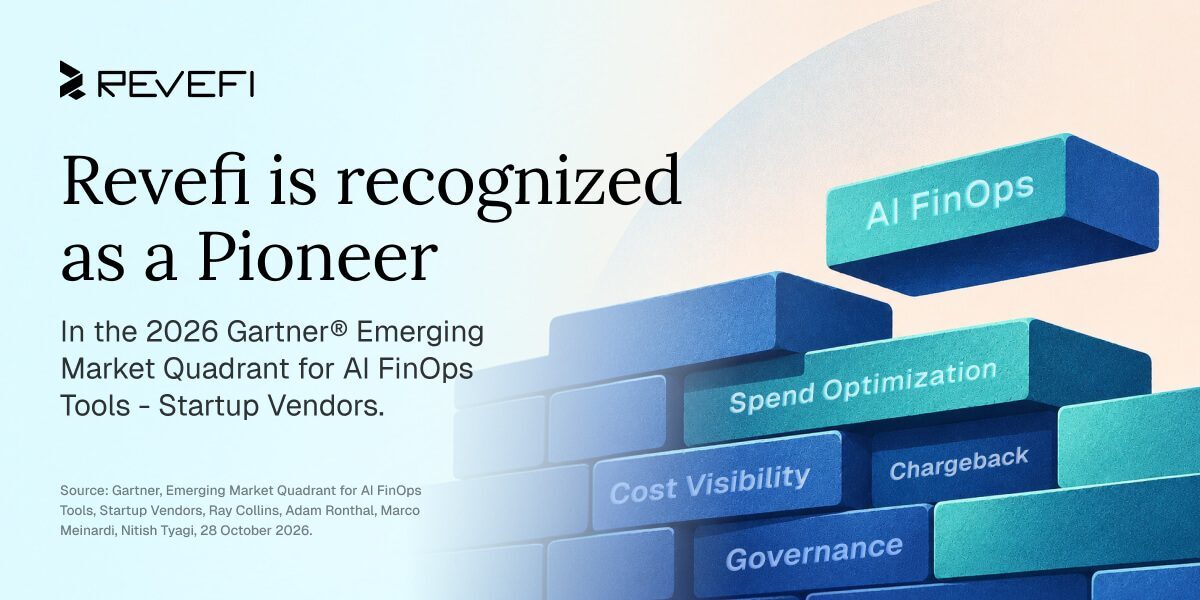
On October 28, Gartner published the 2026 Emerging Market Quadrant for AI FinOps Tools - Startup Vendors. Revefi is recognized as a Pioneer and is positioned furthest on the Potential for Market Disruption axis in the report.
I spent years as an engineer, product manager, and in GTM roles across cloud computing, security, observability, data, and AI. And the pattern in enterprise AI today looks familiar but 10x worse. A new platform arrives, usage grows faster than the tools built to account for it, and finance is the last to find out!
The difference this time is speed.
Gartner’s informative report captures it this way: “The proliferation of GenAI and AI agents has introduced unprecedented cost unpredictability, often making ROI and value alignment elusive.”
Here is what we think the report means for teams running AI in production.
Disruption starts where AI gets built
Gartner is specific about where the disruption in the Pioneers quadrant comes from: "Disruption in this quadrant is driven by shifting governance directly onto developer endpoints and embedding controls upstream at creation time." It also notes that "Pioneers have advanced capabilities for developers, including IDE integrations, harness controls, headless modes and MCP integrations."
That matches how we built Revefi. Governance that runs after the invoice arrives is too late for an agent that can loop all night. So we put AI FinOps where AI is created. The Revefi MCP server and the Claude Code Optimizer work inside Claude Code, the SDK instruments apps as they are built, and the AI gateway enforces budgets in the request path before spend occurs. Finance still gets attribution, chargeback, and forecasts. Engineers get the fix in the tools they already use.
AI FinOps is now its own discipline
Gartner defines AI FinOps tools as "solutions that measure, attribute, forecast, control and optimize AI costs." It frames the work around three problems leaders have to solve: attribution (who is spending what, on which AI capabilities), control (stopping runaway workloads before the invoice) and value (whether the spend was worth it).
Teams are not waiting for vendors to catch up which accelerates our roadmap! Gartner reports "one-third of organizations building their own AI FinOps solutions in-house." We talk to many of those teams. Most have built a dashboard to track tokens; few built simple limits, and none connected AI usage to ROI and the data platforms underneath it.
AI cost doesn't stop at the token
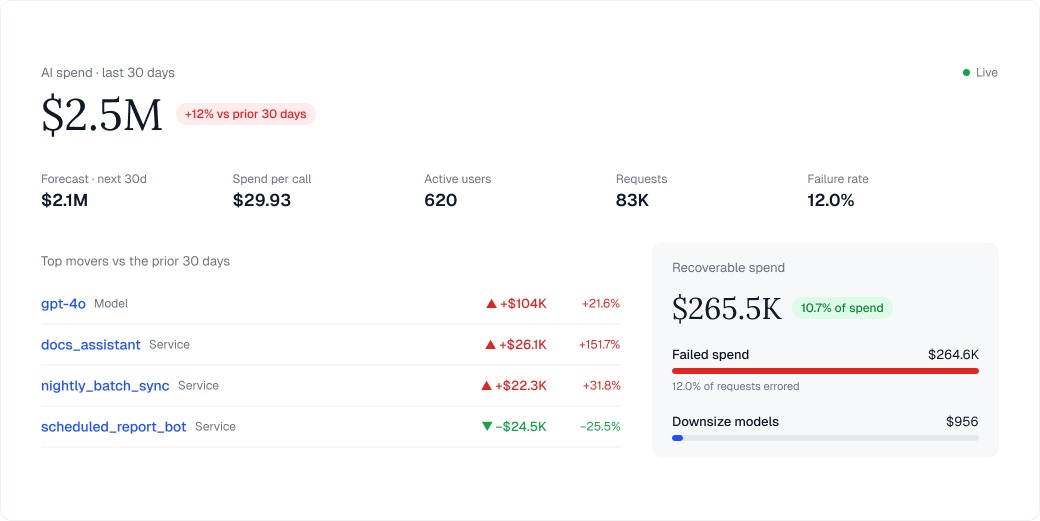
In describing the Pioneers quadrant, Gartner writes that "Measuring AI cost goes beyond counting tokens and multiplying them by publicly listed price per million tokens." The report lists licenses, credits, GPUs, APIs and database costs.
LLM costs dominate financial news, funding, board discussions and engineering conversations. Database costs are the part most AI FinOps conversations skip. An agent that answers a question about revenue calls OpenAI GPT or Anthropic Claude, then queries Snowflake, Databricks or BigQuery, sometimes dozens of times. The tokens show up on one invoice and the warehouse compute on another. Cloud FinOps tools do not see it. LLM tracing tools do not see the first.
Revefi has eliminated this gap. Revefi's roots are in performance, cost, observability and quality for data platforms, and we extended the same approach to LLMs and agents. Today the same platform covers LLMs, agents, apps and the data platforms they depend on.
Agents change the math
One user request can trigger an orchestrator that calls several models, spawns subagents, invokes tools and runs queries. Gartner names the two primary risks the AI FinOps market is tackling: "Building unprofitable agentic AI products or features" and "Coding agents burning unrestricted tokens with no link to value."
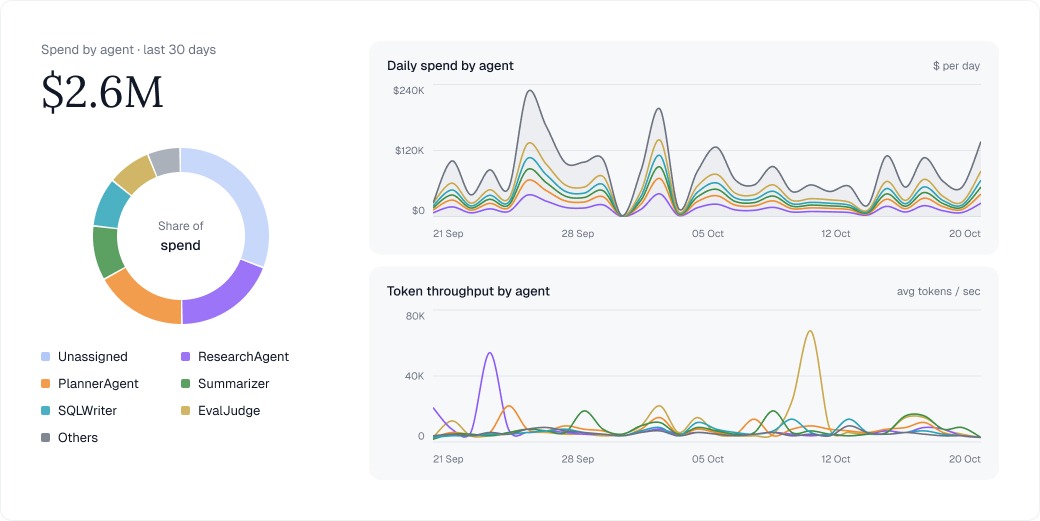
We solved the first risk last year and many customers have benefitted from it. We learnt from the second risk and have solved it for our customers. Our engineers build with Claude Code (and other tools), and we run our own data agents in production. When we looked at our own Claude Code data agents, a prompt caching issue meant conversation history was not being cached. After the fix, cache reads climbed to 99% of input tokens and our Claude Code data agents spend dropped by 90%. The Claude Code Optimizer brings the same discipline to every team: it finds repeated work across Claude Code sessions and suggests more efficient code. Working through the Revefi MCP server, Raden opens a Jira ticket and the pull request for the fix.
What AI FinOps across models, agents, apps and data platforms looks like
Revefi brings four key capabilities into one platform:
- Observe. One view of LLM usage across OpenAI, Anthropic, Google, Amazon Bedrock and Azure OpenAI alongside Snowflake, Databricks and BigQuery, plus licenses and seats. Every interaction is attributed from user to agent to model, to the cent.
- Optimize. Prompt and token optimization, model routing, warehouse and query tuning, and the Claude Code Optimizer. Raden applies recommendations with one click or on its own.
- Govern. Hard and soft caps are enforced at runtime through the Revefi AI gateway or your own, with approval workflows for exceptions and anomaly detection that catches agent loops as they start.
- Prove value. Unit economics per agent, app and team, including the data platform behind each one, plus forecasting for next quarter.
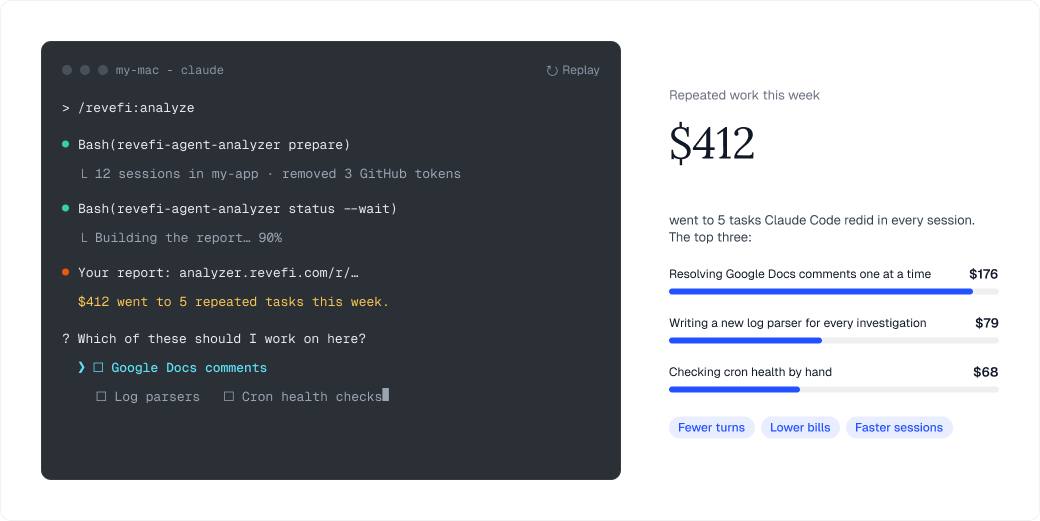
Teams connect through the AI gateway, MCP server, SDK, direct API integrations or their data platforms, depending on how much control they want in the request path.
What it looks like at scale
One of our customers is a Fortune 200 enterprise spending nine figures a year on AI. Its AI spend grew 8x in under four months, across more than 25,000 users, 10,000 AI services and 200 million requests a month. Revefi identified seven-figure savings within three weeks. The savings matter, but the bigger change is that the team can now answer the attribution, control and value questions with data instead of estimates.
What next
Gartner expects the market to evolve, noting it is "increasingly shifting beyond cost reporting toward AI economics management." The capabilities it lists next include agent ROI measurement, cost-to-outcome attribution and dynamic allocation of AI budgets based on observed business value.
Revefi is on the cusp of this already. Knowing what an agent costs is the starting point. Knowing what it returns, including the data platform work behind it, is how AI earns its next budget.
If your teams are running OpenAI, Claude, Gemini or your own AI workloads, Get an AI FinOps Assessment.