.avif)
Database infrastructure and management is undergoing a seismic shift.
The traditional role of a Database Administrator (DBA) has come a long way from a mere IT support staff who once spent their days manually writing SQL scripts, tuning indexes, configuring cluster nodes, and setting up static alert triggers. As Cloud Data Platforms (CDP) like Snowflake, Databricks, Google BigQuery, and AWS Redshift generate millions of execution events per minute, the DBA now faces a daily uphill challenge of staying on top of the entire stack.
And if this wasn’t enough, the advent of agentic AI tools like ChatGPT, Gemini, Grok and Claude has added Large Language Model (LLM) datasets, token burn and multi-agent AI pipelines into the mix!
The result → human-scale database administration breaking down on a regular basis.
Hence, the evolution of the Database Administrator into an AI-first role (AI DBA) was inevitable.
Functioning as a high-impact, modern role that merges foundational database expertise with autonomous AI agents, LLM observability, and continuous cloud FinOps, the AI DBA undertakes traditional database administration tasks and delivers real-time output with the help of autonomous, AI-powered systems.
What Is an AI Database Administrator?
An AI Database Administrator (AI DBA) is a data operations leader who uses self-driving AI agents, AI/ML telemetry, and automated observability platforms to monitor, optimize, and secure enterprise data ecosystems from end-to-end.
Rather than reacting to broken pipelines or hunting through execution logs, an AI DBA manages data systems at scale by orchestrating autonomous tools that tune compute, catch schema drift, and control costs in real time.
Key Responsibilities of an AI DBA
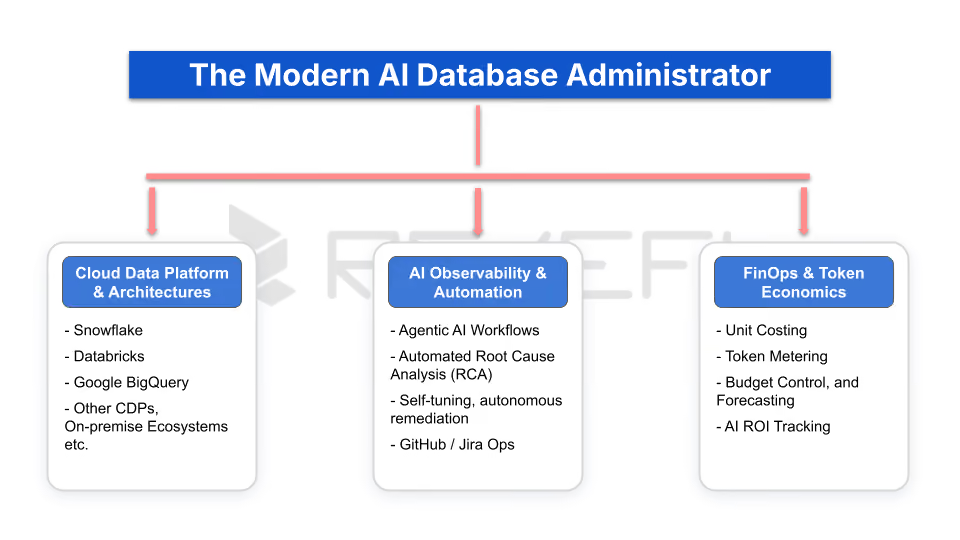
- Autonomous Performance Tuning:
Deploying AI agents that continuously monitor query performance, optimize cluster sizing, and tune execution engines (like switching to vectorized runtimes or updating instance families) without manual intervention. - Generative AI FinOps:
Tracking token economics down to the cent across AI providers like OpenAI, Anthropic, and Google, attributing costs directly to specific models, users, and workloads. - Automated Data Quality & Observability:
Setting up self-adjusting data quality monitors that automatically detect schema changes, missing data, and volume anomalies without human configuration. - Agentic Operations & Developer Integration:
Connecting AI database agents directly into existing developer pipelines using tools like GitHub Actions, Jira, and Model Context Protocol (MCP) servers to auto-generate pull requests for cluster configurations and code fixes.
Why the Traditional DBA Role Is Evolving?
Legacy database management was built for predictable, on-premises databases running on static hardware. Today’s cloud data platforms operate on decoupled compute and storage with pay-as-you-go pricing models. While this setup delivers incredible speed, it brings major operational headaches:
- Unpredictable Spend Spikes:
Cloud warehouses scale instantly. A single runaway query or poorly configured auto-scaling rule can burn through tens of thousands of dollars before anyone notices. - The GenAI Explosion:
As companies deploy LLMs and multi-agent workflows into production, databases aren't just storing text and numbers. Today, they are executing non-deterministic LLM pipelines where compute and API costs stack up rapidly. - Severe Alert Fatigue:
Traditional static alerting rules either bombard teams with false alarms or stay quiet until a crucial business dashboard breaks. - Scale Beyond Human Capabilities:
Enterprise environments manage thousands of tables, millions of API requests, and massive compute pools. Manually inspecting query execution plans for every job is no longer feasible.
Platform data shows that organizations using self-driving AI platforms routinely cut cloud compute spend by 30% to 70% while boosting operational efficiency tenfold.
The AI DBA is the architect who makes that happen.
Core Competencies: Skills You Need to Master To Succeed as an AI DBA

1. Cloud Data Warehousing & Lakehouse Architecture
You must know how modern, decoupled compute-and-storage engines operate under the hood:
- Snowflake:
Multi-cluster virtual warehouses, micro-partitioning, and credit consumption optimization. - Databricks:
Apache Spark execution plans, Delta Lake optimization, Auto Loader, and vectorized runtimes like Photon. - Google BigQuery:
Partitioning, clustering, slot management, and concurrency scaling strategies.
2. Agentic AI & Autonomous Observability
An AI DBA doesn't spend hours writing custom monitoring scripts—they deploy smart agents to do the heavy lifting:
- Agentic Workflows:
Understanding how autonomous software agents evaluate telemetry, conduct root-cause analysis (RCA), and implement remediation steps. - Developer Workflows:
Connecting database AI agents directly into developer tools like GitHub, Jira, and Claude Code using Model Context Protocol (MCP) integrations. - Zero-Touch Quality Assurance:
Setting up self-tuning monitoring systems for data freshness, volume, and lineage tracking.
3. Financial Engineering & LLM Token Economics
Modern database management requires deep financial discipline:
- Cloud FinOps:
Building cost-attribution tagging models, forecasting workloads, and setting automated budget safety controls. - LLM Metering:
Tracking token counts (input vs. output), call latency, prompt drift, and model-level cost attribution across OpenAI, Anthropic, and Google.
The Step-by-Step Roadmap to becoming a DBA in the AI Era
Whether you are currently a Data Engineer, Cloud SysAdmin, or traditional DBA, follow this clear roadmap to make the pivot.
Step 1: Master Cloud Infrastructure Internals
Shift your thinking away from traditional disk-and-table mechanics toward cloud-native compute parameters. Learn how compilers parse jobs, how micro-partitioning influences execution cost, and how cluster auto-suspend settings directly impact monthly cloud bills.
Step 2: Get Hands-On with AI Agents
The hallmark of an AI DBA is orchestrating AI agents rather than running manual scripts. Experiment with agentic frameworks and protocols like Model Context Protocol (MCP). Learn how to use AI agents to automate routine infrastructure maintenance, such as updating cluster node types (e.g., migrating to Graviton instances) or applying performance tweaks via automated GitHub PRs.
Step 3: Implement Automated RCA and Observability
When a data pipeline breaks, don't spend hours digging through logs. Build unified DataOps environments that use automated anomaly detection, track end-to-end data lineage, and map technical pipeline failures directly to downstream business impacts.
Step 4: Master AI Token Economics
As companies build generative AI features, budgets are shifting toward model APIs and vector searches. Learn how to track cost-per-token across different model providers, implement prompt optimization to lower consumption without sacrificing quality, and establish guardrails to audit LLM calls for latency and cost drift.
Step 5: Transition to a Self-Driving Posture
Stop adjusting database configurations manually. Move your entire IT team toward a self-driving model where continuous monitoring tools detect idle resources, identify unused tables, and pinpoint inefficient join conditions. And the final step? Relying on AI-powered database management tools that let you fix or optimize your data environment with just a single click!
Working Methodology: Traditional DBA vs. AI DBA
The primary difference between understanding how an AI DBA works v/s the traditional role of an AI DBA is getting to know the key operational methodologies behind the roles. That is broadly broken down into sections in the table below.
Elevating Your Career Impact: The Path Forward
The DBA role isn't disappearing, but is rather getting an upgrade. Moving into the AI DBA space elevates your status from a back-office administrator to a strategic tech leader.
As enterprises double down on multi-agent AI features and auto-scaling cloud platforms, demand for professionals who know how to manage, optimize, and secure these complex systems will keep rising. By leveraging autonomous platform management tools, modern AI DBAs deliver immediate business value through:
- Substantial Cost Savings
- Performance, and Efficiency Gains
- Elimination of routine and repetitive maintenance tasks
- Complete Visibility
By pairing deep data platform knowledge with autonomous AI workflows and continuous FinOps, you can position yourself at the absolute center of modern data operations.
About Revefi:
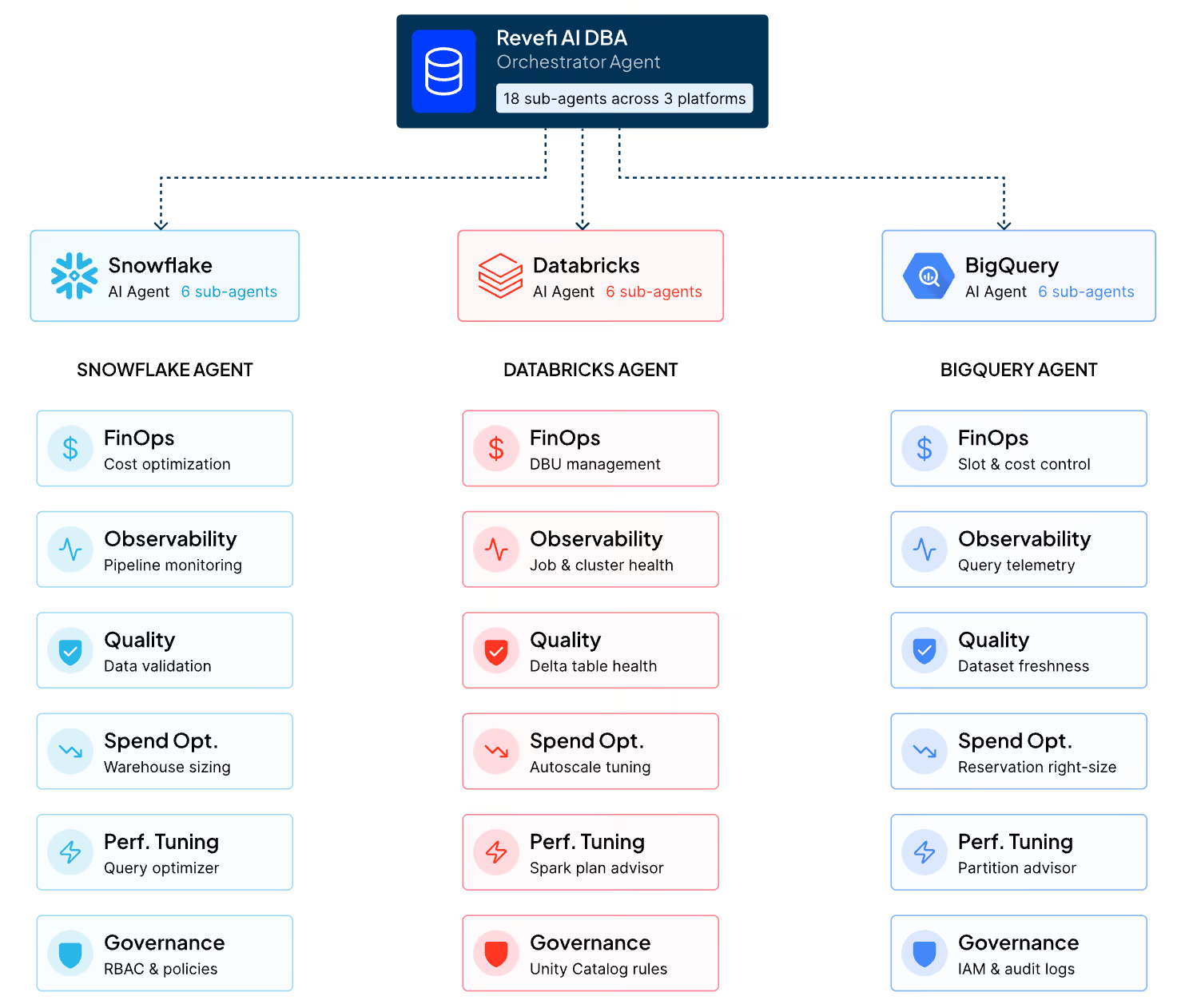
Revefi AI DBA is an autonomous Database Administrator platform that includes 18 specialized AI agents to manage cloud data platforms, specifically Snowflake, Databricks, and Google BigQuery. Running 24/7 with zero manual overhead, the platform is designed to reduce cloud data costs by 30% to 70%, achieve over 400% annual ROI, and deliver its first insights within an average of five minutes.
The architecture features a plug-and-play, read-only, metadata-only setup that requires no touch to deploy. The core framework assigns a dedicated team of six domain-expert sub-agents to each of the three supported platforms.
Get in touch with our experts today to learn more about Revefi’s suite of solution, and how we can help you get your data team up to speed.