I've spent my career obsessing over databases and performance from my time doing database research at Microsoft Research, to building systems at Google, to co-founding ThoughtSpot. Over all those years, I've watched the DBA role evolve. But nothing I've seen compares to what's happening right now. We are at an inflection point, and I want to be direct: the way we've managed databases for the past 30 years is broken. Native AI solutions are here to fix it.
The Old Model Has a Hard Ceiling
Let me paint a picture that every DBA and data engineering leader will recognize.
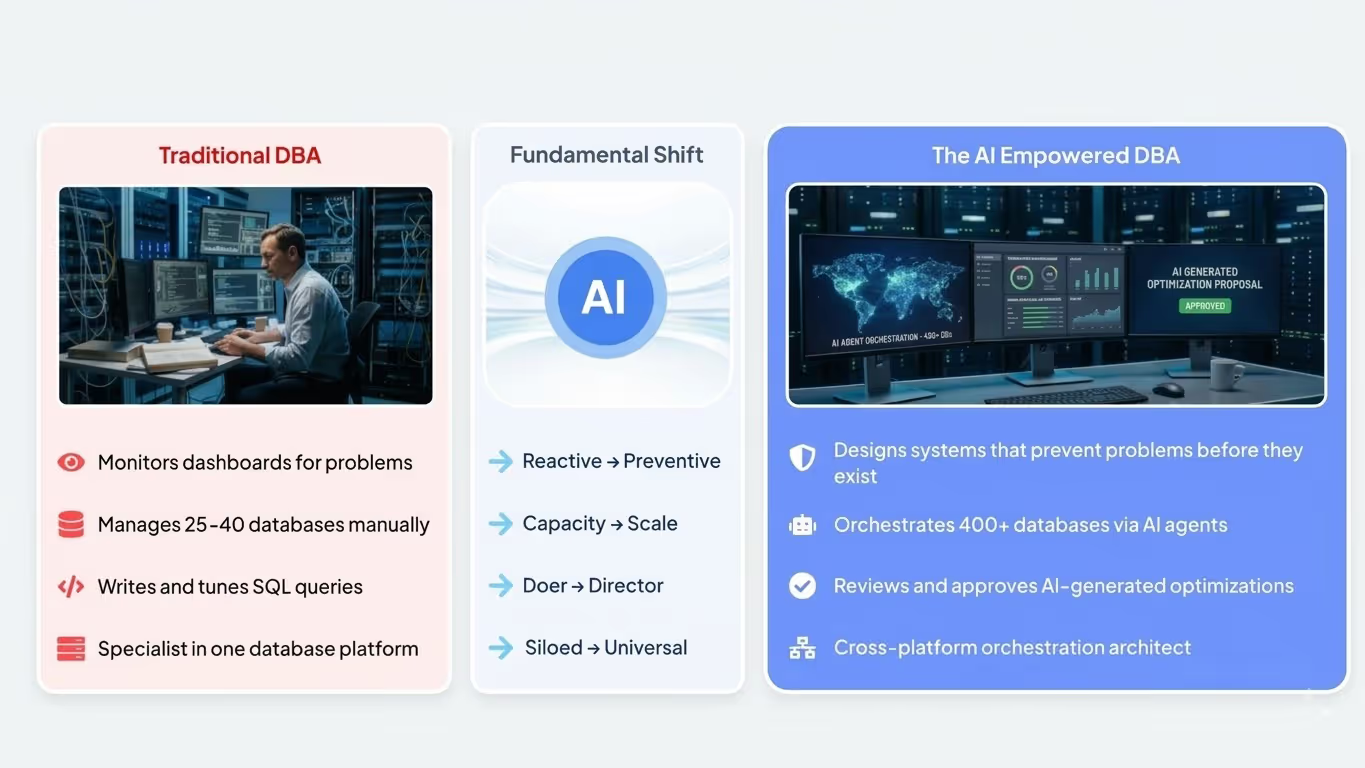
You've got a skilled DBA, maybe your best one who manages 30 to 40 databases. The DBA is monitoring dashboards, waiting for something to go wrong and gets paged at 2am. The DBA spends hours triaging an incident that, in retrospect, probably could have been predicted days in advance. After reviewing slow queries when someone files a ticket, but by then the damage is done and they're already behind on the next five things in the queue.
I've seen this pattern at companies of every size. And here's the fundamental problem: it doesn't scale. You cannot grow your data infrastructure without linearly growing your DBA headcount. That's not a people problem; it's a structural one.
When I look at cloud data spend across our customers, I see organizations spending millions more than they need to simply because no one has the bandwidth and understanding on how to continuously optimize. Monthly billing surprises. No one quite knowing why spend spiked. Performance degradation that gets caught too late. These are failures that can be fixed today.
The Shift I Believe Is Inevitable
Here's what I know from decades of working on database internals and enterprise data systems: the bottleneck has never been intelligence. DBAs are extraordinarily capable people. The bottleneck has always been time and scale.
AI agents change that equation entirely.
I think about this as four fundamental shifts that are happening whether we embrace them or not:
Reactive to Preventive. The best DBAs I've worked with have always had a sixth sense for problems they'd catch a pattern in query execution plans before it became an incident. AI can now do that continuously, across every workload, every hour of the day. We move from fighting fires to preventing them.
Capacity to Scale. A traditional DBA can effectively govern around 40 databases. With AI agents acting as force multipliers, that same DBA can oversee 400+. We're not replacing anyone, rather we're removing an artificial ceiling.
Doer to Director. This is the shift I find most exciting, because it elevates the DBA's role rather than diminishing it. Instead of writing and executing every optimization manually, the AI-empowered DBA reviews AI-generated proposals and applies their hard-won expertise to approve, refine, or reject them. Human judgment is still absolutely essential but it operates at a higher level.
Siloed to Universal. The days of being "the Snowflake DBA" or "the Redshift DBA" are giving way to cross-platform orchestration. When AI handles the platform-specific mechanics, the DBA becomes an architect who governs across the entire data estate.
What This Looks Like in Practice
At Revefi, we built our platform specifically to enable this transformation and I want to give you a concrete sense of what it means day to day.
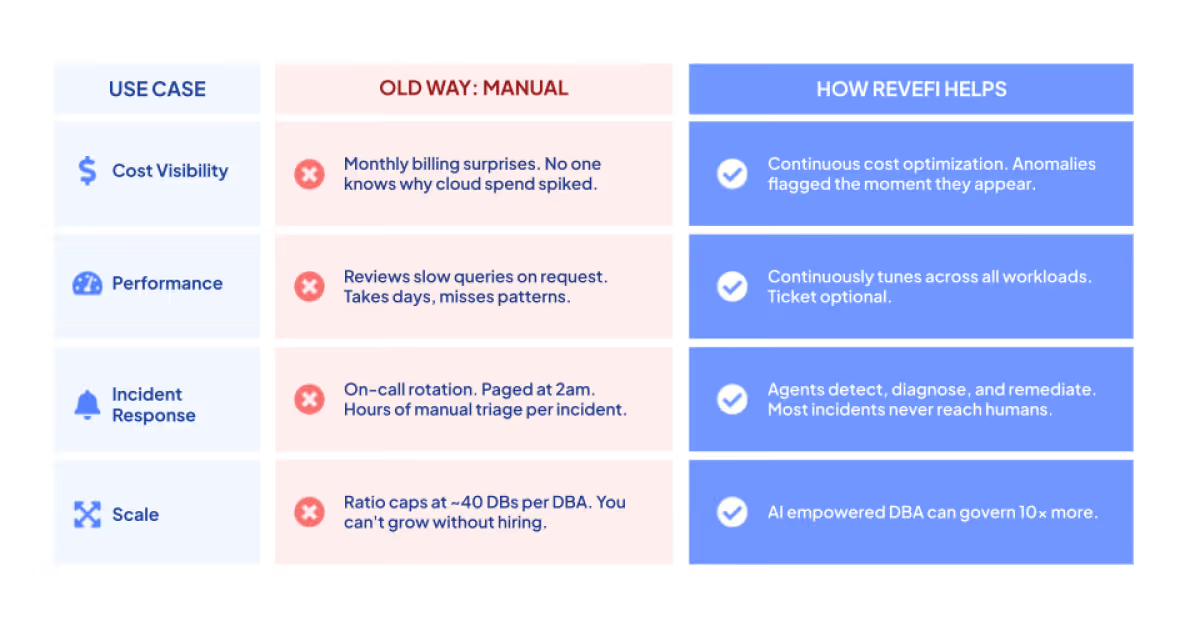
On cost visibility: rather than discovering a $200K cloud bill spike at month-end with no clear cause, you get continuous monitoring with anomalies flagged the moment they appear. One of our Fortune 500 customers went from monthly billing surprises to having spend variations explained and attributed in real time. We've seen customers achieve up to 60% reduction in data spend, sometimes saving $10 million or more.
On performance: slow query review shouldn't require a ticket and a three-week wait. Our platform continuously tunes across all workloads, identifying and addressing performance patterns proactively. The ticket becomes optional, not the only trigger.
On incident response: this one is personal for me, because I know what it's like when a database incident cascades into a business-critical outage. AI agents can now detect, diagnose, and remediate the vast majority of incidents autonomously. Most never reach a human at all. The on-call rotation still exists, but the 2am pages become rare rather than routine.
The Skills That Will Define the Next Generation of DBAs
I want to be direct to the DBAs and data professionals reading this, because I have a lot of respect for what you do and I want to be honest with you about what's coming.
Your classical database skills, query optimization, schema design, understanding execution plans, knowing your storage and compute tradeoffs those still matter deeply. They're the foundation. But they're no longer sufficient on their own.
The DBAs who will thrive in the next five years are the ones who become experts in how AI and data systems work together. The ones who learn to use AI agents as force multipliers rather than fearing them as replacements will thrive. The ones who develop fluency in FinOps and DataOps, understanding the business and cost dimensions of every infrastructure decision will excel. I encourage you to become power users of LLMs and AI tooling.
The destination is becoming someone who drives measurable business outcomes from data infrastructure, not just someone who keeps the lights on.

Are You Ready?
I genuinely believe that we are at one of those rare moments where the rules of the game change fast, and the people who move early will have a significant advantage.
The AI DBA isn't coming. It's here. The question is whether you're going to shape what that looks like in your organization or let it happen to you.
You can watch the entire session here: The Role of the DBA in 2026:Changes, Challenges, and Opportunities
I'd love to hear where you are on this journey. Reach out to me.