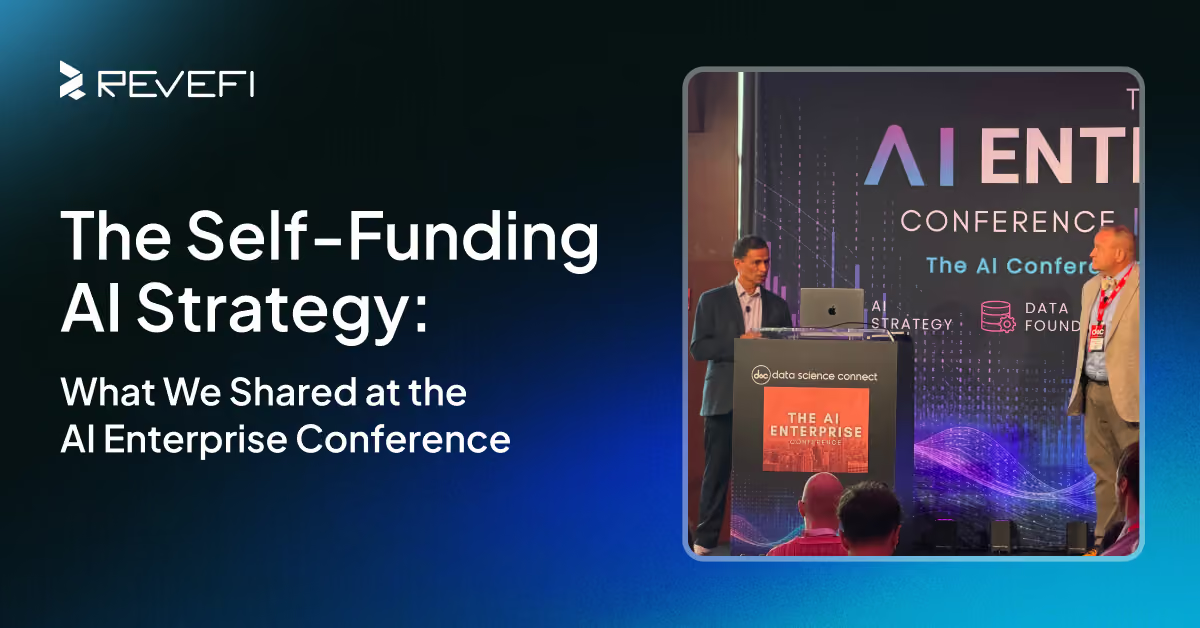
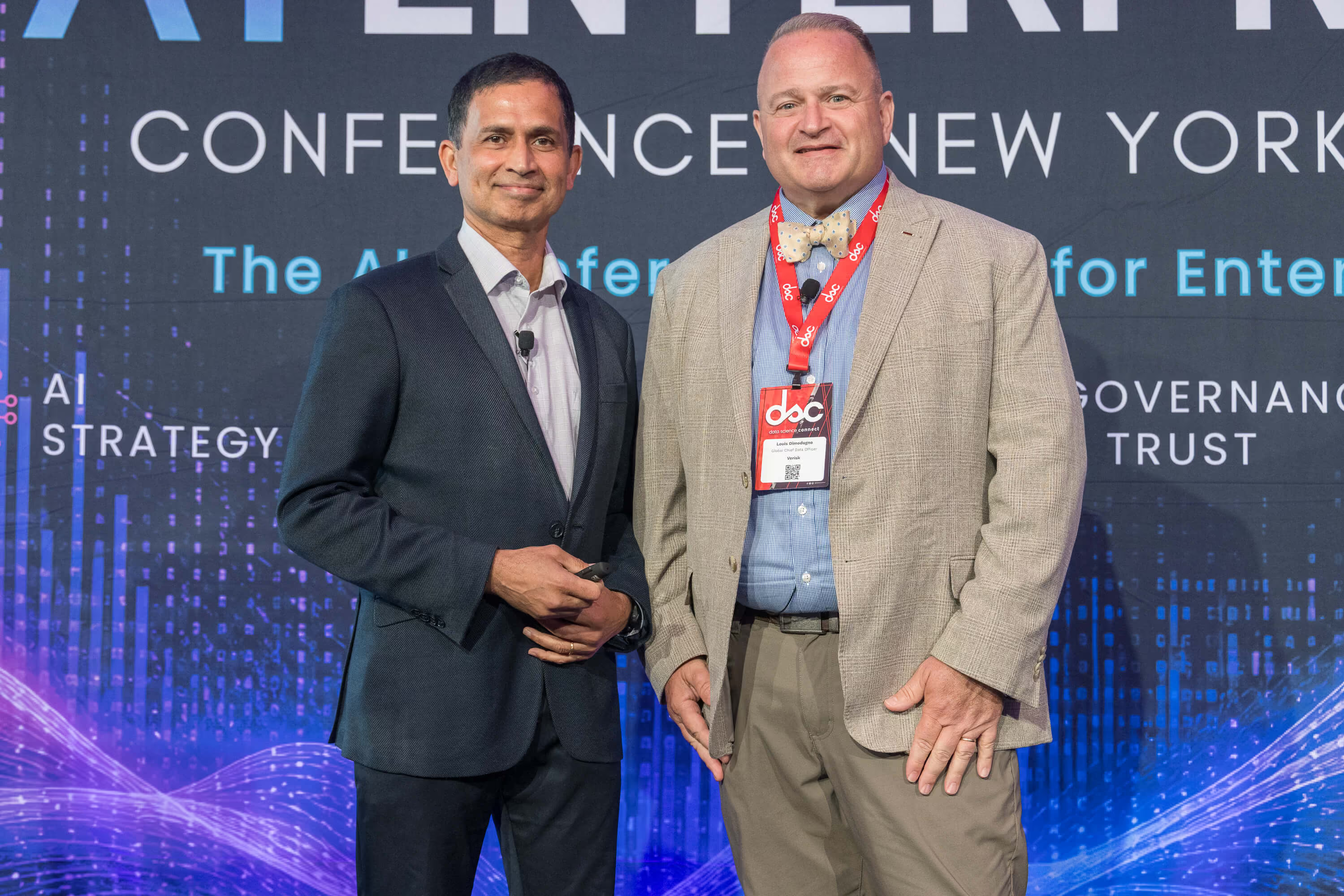
On September 1, 2026 at AI Enterprise Conference in New York, Louis DiModugno, Global Chief Data Officer of Verisk, and I took the stage on the Economics of AI track to discuss how the best-funded AI programs of 2027 will not have bigger budgets., rather they will have AI that funds itself.
Over a 25-minute fireside conversation, Louis and I unpacked what that actually means in practice, from a Fortune 500 insurer that found $3M in annualized savings in 48 hours to Verisk's own 60% warehouse cost reduction. Here is the conversation in full.
The AI budget paradox
Every enterprise AI program in 2026 is caught in the same squeeze. Boards expect AI everywhere. CFOs expect measurable ROI before approving larger investments. And most AI business cases live in the gap between the two, built on projected productivity, estimated revenue lift, and someday-savings that finance teams rightly discount.
What survives budget review is realized dollars. So the strategic question is not "which AI use case is most exciting?" It is "which one produces cash first?"
Our answer: do not ask for a bigger budget. Point AI at the operational waste already embedded in your data, infrastructure, and AI operations, and let the savings fund what comes next.
Hire your first AI team mate: the one that finds money
Modern data and AI infrastructure routinely carries 30% to 70% waste: idle compute, unoptimized workloads, redundant processing, oversized everything. Humans do not find it because the surface area outgrew human attention years ago. Finding it takes an agent that watches everything, all the time, and acts.
That is why we argue the first AI that should touch production is not customer-facing. It is the one auditing the machines. Autonomous optimization is the rare AI use case with instant, CFO-legible ROI, because it cannot hallucinate a saving. The invoice either shrinks or it does not.
The proof point that got repeated in the hallway afterward: a Fortune 500 insurer pointed an AI agent at its own infrastructure and identified $3M a year in recoverable savings in 48 hours, with zero disruption to the business. Not a quarter-long cost program. Two days.
The Verisk perspective: making self-funding real at scale
The heart of the session was Louis's view from the enterprise side: how a Fortune 1000 data and analytics leader connects AI investment to measurable business outcomes, and where the self-funding model proved itself first.
Verisk's results speak plainly:
- 60% reduction in warehouse costs through autonomous data cloud optimization
- 100% projected ROI on the program
- 665,000+ monitors running continuously across the data estate
Louis's larger point: the discipline matters as much as the dollars. Connecting AI investment to business outcomes means treating recovered savings as visible, bankable capital, the kind a CFO can redirect into the next wave of initiatives, rather than letting efficiencies quietly evaporate back into the run-rate.
Tokenomics: the new sprawl is already here
The second half of the conversation turned to where enterprise AI spend is heading, and why the self-funding discipline has to extend to AI workloads themselves.
Louis made the case for token-consumption transparency as a first-order requirement. As LLM workloads scale, enterprises need the same visibility into token spend that they fought for years to get on cloud and data spend. Girish added the infrastructure-market view that unmanaged AI spend a compounding risk rather than a rounding error.
The pattern is familiar. AI workloads are repeating infrastructure's history: invisible costs, silent failures, unattributed spend, humans double-checking everything. Which leads to the session's second rule: every AI you fund should ship with its economics instrumented from day one, covering cost per outcome, failure costs, and oversight burden. AI funds AI. Then AI audits AI.
The playbook: four moves to start this quarter
We closed with the takeaways slide, and it is worth restating in full:
1. Baseline your waste
- Audit your data and AI infrastructure spend starting now.
- Assume 30%+ is recoverable until proven otherwise.
- Treat found waste as your AI program’s seed capital.
2. Deploy an optimizer first
- Make autonomous optimization your first production AI.
- Bank realized savings, not projected ones.
- Build CFO trust with realized proof.
3. Instrument from day one
- Every funded use case has cost-per-outcome metrics.
- Track failure and oversight costs, not just tokens.
- Make optimization continuous, not a quarterly audit.
4. Ring-fence the savings
- Commit reclaimed dollars to the AI portfolio.
- Make the flywheel explicit in budget planning.
- Report reinvestment, not just savings.
The bottom line
The enterprises that win at AI will not be the ones with the biggest budgets. They will be the ones that turned AI loose on their own costs first, and let it pay its own way in.
Thanks to Louis DiModugno and the Verisk team for bringing the enterprise perspective, and to everyone who packed the room and found us afterward.
Want to know what an AI agent would find in your infrastructure? Talk to Revefi and we will show you what 48 hours of autonomous optimization looks like against your own estate.