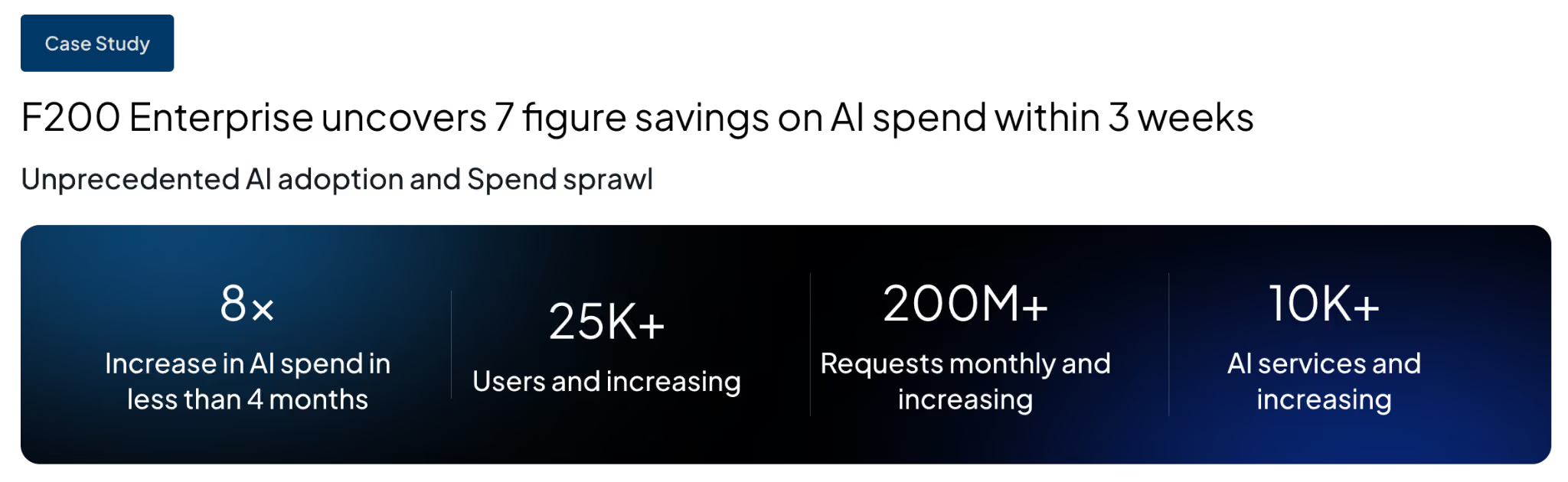
Enterprise artificial intelligence spending is undergoing a structural shift. Gartner research indicates that nearly 90% of finance leaders feel intense pressure to tie AI investments directly to concrete business outcomes, yet only 22% have successfully established clear ROI tracking mechanisms.
As enterprises move from isolated generative AI prototypes to autonomous agent swarms and real-time multi-modal pipelines, traditional cloud cost management tools are failing. Conventional cloud infrastructure relies on deterministic compute pricing based on provisioned virtual machines, memory allocation, and static execution paths. AI workloads operate non-deterministically.
The resulting bills arrive with limited attribution and little connection to business results. FinOps for AI is the discipline that brings financial control to this environment.
Costs fluctuate based on token counts, dynamic context window scaling, agentic execution loops, vector database embeddings, GPU cluster duty cycles, and multi-modal payload variations. Without rigorous unit economics and continuous financial governance, AI initiatives risk turning into financial black holes.
That rapid expansion has not been matched by equivalent maturity in attribution or unit economics. Many organizations still struggle to answer a basic question: which product feature or agent drove the majority of last month's token bill?
This article:
- Focuses on FinOps for AI in the 2026 context
- Distinguishes it from related practices
- Examines the specific cost dynamics of agents and multi-modal systems
- Outlines the capabilities data leaders need to implement
FinOps for AI vs. AI FinOps: understanding the tactical difference
While industry discussions frequently treat FinOps for AI and AI FinOps as interchangeable synonyms, modern enterprise architecture teams make a clear technical distinction between the two concepts. Understanding this taxonomy is vital for structuring team responsibilities, governance policies, and tool stack selection.
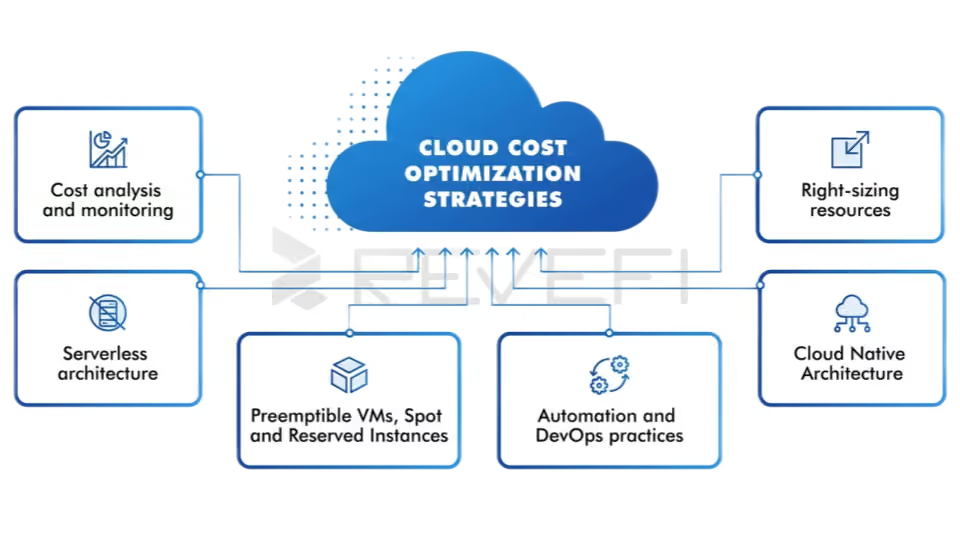
FinOps for AI
FinOps for AI refers to the management framework, data pipelines, allocation policies, and optimization strategies used to manage, track, and optimize the operational expenditure of artificial intelligence workloads.
It adapts core financial operations principles (Inform, Optimize, Operate) specifically to AI infrastructure. The primary goal is to establish unit economics for machine learning operations (MLOps) and generative AI architecture. It answers operational questions like:
- What is the exact inference cost per completed user transaction in our customer support AI agent workflow?
- Are our self-hosted Llama 3 70B models running on AWS EC2 p5.48xlarge instances more cost-effective per 1,000 requests than calling a managed frontier model API?
- How much are our RAG (Retrieval-Augmented Generation) pipelines burning on vector storage index refreshes in Pinecone or Qdrant?
AI FinOps
AI FinOps, often called AI-driven cloud financial management, refers to the use of machine learning algorithms, predictive models, and generative models to automate traditional cloud cost management processes.
Instead of engineers writing static rules to spot idle resources or project monthly cloud spend, AI FinOps platforms apply predictive modeling to cloud consumption telemetry. Key capabilities include:
- Predictive anomaly detection that flags cloud cost spikes before billing periods end
- Machine learning algorithms that continuously analyze spot instance availability and auto-scale node pools with minimal eviction risk
- Dynamic commitment managers that buy and sell Reserved Instances (RIs) or Savings Plans based on enterprise usage telemetry
In short: FinOps for AI is the management framework used to keep AI model and infrastructure costs under control, while AI FinOps uses machine learning to optimize general cloud billing and IT infrastructure operations.
The economics of modern agentic AI and AI system workflows
Managing financial operations for standard cloud data platform (CDP) workloads requires analyzing CPU, RAM, network egress, and storage capacity. AI architectures introduce unique cost variables across three execution layers: LLM API inference, autonomous AI agents, and multi-modal pipelines.
Cloud cost platforms excel when resources carry consistent tags. AI spend frequently lacks those tags.
LLM calls originate from application code, agent frameworks, or third-party tools that do not propagate organizational metadata. Bills arrive 24 to 48 hours after consumption. A recursive agent can exhaust a monthly budget before any dashboard reflects the anomaly.
Cost drivers are also qualitative. Prompt design, system-message length, tool catalog size, retrieval depth, and the number of self-reflection steps all influence token volume independently of infrastructure. Multi-modal workflows introduce additional pricing dimensions that pure infrastructure tools cannot interpret. When agents query Snowflake, Databricks, BigQuery, or similar systems, warehouse compute and storage charges become part of the same economic picture.
Large language model inference mechanics
LLM cost structures deviate from traditional request-response web service APIs. Pricing is governed by input and output tokens, context window management, and model routing decisions.
1. Token dynamics and context window scaling
LLM providers bill separately for prompt (input) tokens and completion (output) tokens. Output tokens generally cost three to four times more than input tokens due to autoregressive generation, which requires sequential matrix multiplications across GPU memory bandwidth for every generated character.
As developers expand context windows to 128k, 200k, or 1M tokens to improve context quality, prompt costs escalate non-linearly. Without prompt caching mechanisms, submitting a 100,000-token system prompt on every API call quickly exhausts cloud budgets.
2. Self-hosted vs. managed API cost matrices
When self-hosting open-source LLMs such as DeepSeek-R1, Llama 3.1 405B, or Mistral Large on cloud infrastructure like AWS EKS, Azure AKS, or GCP GKE, pricing shifts from variable token-based consumption to fixed hourly compute fees. FinOps teams must continuously calculate the crossover point where enterprise query volume justifies moving from managed APIs to dedicated GPU infrastructure running frameworks like TensorRT-LLM or vLLM.
Non-deterministic execution loops of autonomous AI agents
Traditional software executes fixed code pathways with predictable cost structures. Autonomous AI agents run in non-deterministic, agentic execution loops (e.g., ReAct, Plan-and-Solve architectures). An agent receives a goal, formulates a plan, calls external tools, reads the output, re-evaluates its plan, and iterates until the goal is achieved or a timeout threshold is reached.
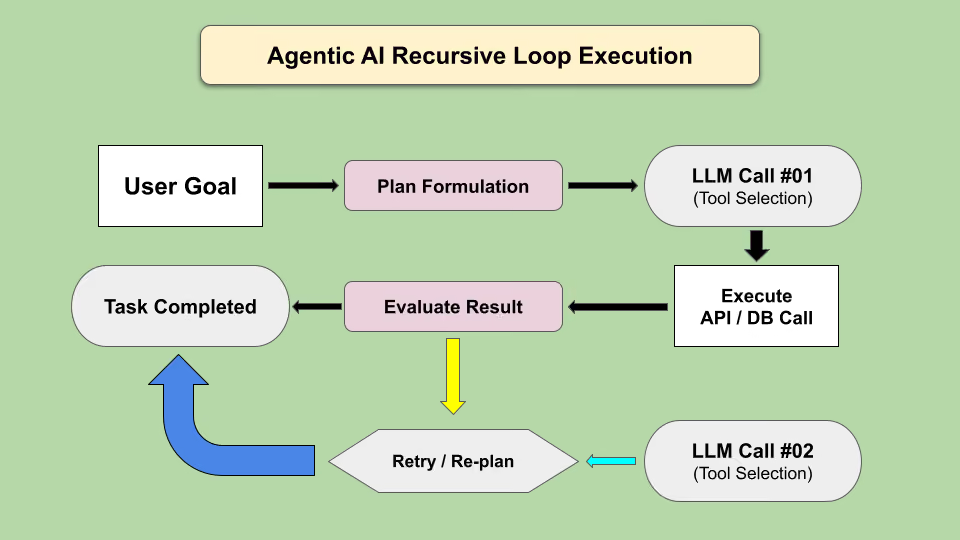
The cost traps of recursive agent loops
- Infinite reasoning loops. An agent stuck on an outlier case may recursively query an LLM dozens of times, generating thousands of context-heavy tokens per loop. A single stuck agent instance can incur heavy costs if execution boundaries are not enforced.
- Context accumulation. With each turn in an agentic workflow, the prompt grows larger because it includes the history of past steps, tool outputs, and error messages. Step 10 of an agent loop can cost roughly 10x more tokens than step 1.
- Multi-agent swarm amplification. In frameworks like AutoGen, CrewAI, or LangGraph, an orchestrator agent spawns sub-agents such as researcher, writer, and code reviewer. Token consumption scales sharply with the number of sub-agents and the back-and-forth validation between them.
Multi-modal workflows: audio, vision, and spatial compute data
Multi-modal workflows process text, high-resolution images, video frames, and audio inputs simultaneously, introducing new cost vectors.
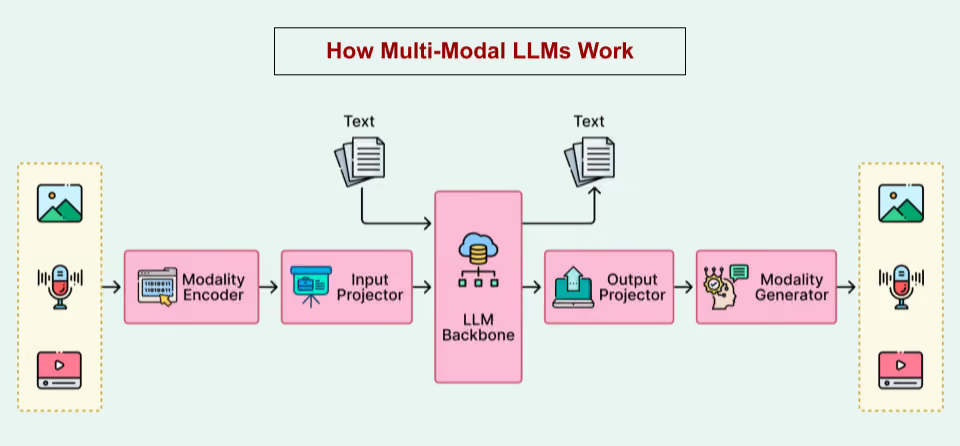
1. Vision encoders and image tokens
Large vision models convert images into visual tokens based on resolution and patch size. A single high-resolution architectural schematic or medical scan can translate into thousands of input tokens.
2. Audio transcription and generation
Processing audio payloads requires speech-to-text models before feeding context to an LLM, followed by text-to-speech synthesis. This adds distinct API charges or specialized GPU inference runs to the total pipeline cost.
3. Vector embeddings at scale
Multi-modal RAG systems require continuous vector embedding generation and storage within vector databases. Vector dimensions, indexing methods (HNSW vs. IVF), and payload storage directly impact RAM and SSD infrastructure costs.
Senior AI and data leaders therefore need observation at the request level, enrichment of missing attribution, correlation of token spend with latency and quality metrics, and policy enforcement before spend occurs. Approaches that require code changes in every agent and pipeline rarely scale across an enterprise estate.
Token economics and the compounding effect of agents
Tokens remain the fundamental unit of AI cost. Providers price input and output separately. Cached tokens receive steep discounts when system prompts or context prefixes remain stable. Batch processing offers further reductions for non-latency-sensitive work.
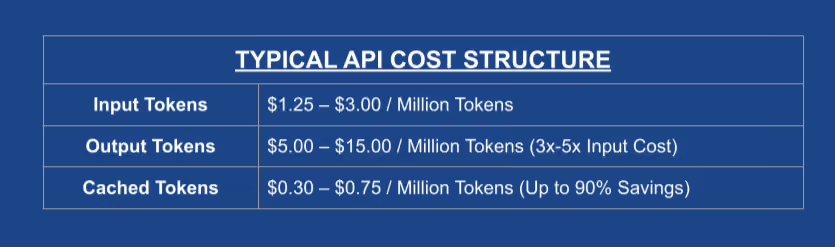
In agentic systems the economics compound. An agent may resend growing context on every step, re-retrieve documents, and invoke tools that themselves call models. Research from 2026 shows that a majority of an agentic task's cost is often tied to refinement, checking, and re-verification rather than the initial generation. Context management, history summarization, and tool pruning therefore become first-order levers.
Cloud data platforms amplify the effect. Agents that query warehouses or lakes generate compute and storage charges outside the pure token line item. Vector stores used for retrieval add their own consumption patterns. Effective FinOps for AI unifies token telemetry with cloud data platform cost data so leaders see the complete footprint of an intelligent workflow.
Industry examples illustrate the stakes. Some enterprises have reported individual agent projects overshooting budgets by factors of 2.4 or higher, and organizations estimate that roughly one-quarter of AI spend may be wasted when ownership and visibility remain incomplete.
Visibility, attribution, and governance requirements
The foundation remains visibility.
Organizations need end-to-end tracing from user request through agent actions to final model responses, including token counts, latency, failures, and cost at each stage. Unified monitoring across multiple providers eliminates the need to stitch together separate vendor dashboards.
Reliable attribution requires detection of missing metadata, including organization, service, model, user, and agent identifiers, before incomplete telemetry undermines reporting. Once attribution is solid, costs can be allocated across business units, cost centers, and hierarchies. Adoption metrics reveal which teams or products drive the majority of spend and which under-utilize available capacity.
Governance moves from reactive alerts to proactive policy. Hard or soft spend caps can be enforced at runtime across providers. Approvals and exception workflows allow legitimate high-value work while preventing uncontrolled burn. Audit-ready records support compliance and internal chargeback.
These capabilities map directly onto cloud data platform operations. When AI agents query CDP resources, the same attribution and policy frameworks can extend to warehouse compute and storage, creating a coherent financial picture of the entire intelligent data stack.
Optimization levers that move the needle in 2026
Once visibility and attribution exist, optimization becomes systematic. High-impact levers observed in production environments include:
- Model selection and routing that directs simple classification or extraction tasks to lower-cost models while reserving frontier models for complex reasoning
- Prompt engineering and caching that maximize cache hit rates and minimize repeated system-prompt tokens
- Context window management through summarization or sliding windows that prevent unbounded growth
- Tool catalog pruning so agents load only the functions required for the current task
- Batch and asynchronous processing for workloads that tolerate higher latency
- Quality-aware measurement that correlates token spend with output accuracy or business outcome metrics, allowing teams to retire low-value prompts and agents
These techniques routinely deliver substantial reductions in effective cost per task without sacrificing required quality thresholds. The savings can be reinvested into higher-value AI capabilities.
Integrating FinOps for AI with cloud data platform cost management
Senior data leaders already manage significant spend on cloud data platforms. AI agents that rely on those platforms create a new intersection of costs. Query acceleration, embedding storage, real-time feature retrieval, and data movement all become part of the AI economic model.
Effective practice treats CDP and AI spend as a unified domain. Cost allocation must span both. Forecasting must account for interaction effects, because more capable agents may drive higher query volumes or larger vector indexes. Governance policies should apply consistently, so that a budget guard on an agent also constrains the cloud data platform resources it is permitted to consume.
Zero-touch integration approaches that observe both AI traffic and platform telemetry without requiring code changes in every pipeline accelerate adoption and reduce engineering overhead. The result is a single source of truth that finance, data engineering, and AI platform teams can trust.
Building a practical FinOps for AI capability
Organizations do not need an entirely new operating model. They can extend existing FinOps practices with AI-specific capabilities. A pragmatic sequence looks like this:
- Establish baseline visibility across all AI providers and agent frameworks currently in use. Capture token volume, cost, latency, and basic attribution.
- Close attribution gaps by detecting and enriching missing metadata at the observation layer.
- Define ownership and budget structures that map AI spend to the same cost centers used for cloud and data platforms.
- Implement real-time policy enforcement and anomaly detection so spend is controlled before invoices arrive.
- Measure unit economics such as cost per successful agent task, cost per user interaction, and cost relative to revenue or productivity gains.
- Continuously optimize through model routing, prompt and context improvements, and retirement of low-ROI workflows.
- Expand the scope to include multi-modal and adjacent infrastructure costs so the full economic picture remains visible.
Collaboration remains essential throughout. Data platform teams bring deep knowledge of query and storage economics. AI engineering teams understand model behavior and agent design. Finance teams supply the accountability frameworks. FinOps for AI succeeds when these groups operate from shared data and shared goals.
Looking ahead: sustainable scale for agents and multi-modal systems
By late 2026, the organizations that treat FinOps for AI as a first-class discipline will possess clearer unit economics, tighter governance, and the ability to scale agent fleets without proportional cost growth. Those that continue to manage AI spend through monthly vendor invoices and spreadsheet reconciliations will face recurring budget shocks and constrained innovation.
Technologies will keep evolving with new model families, more sophisticated agent protocols, and tighter integration between AI runtimes and cloud data platforms. The underlying principles remain stable: visibility at the request and workflow level, accurate attribution, proactive controls, and continuous measurement of cost against value.
FinOps for AI is not merely a cost-cutting exercise. It is the financial operating system that allows enterprises to deploy AI agents, LLMs, and multi-modal systems at the scale their strategies demand while preserving accountability and predictability. For senior data leaders, mastering this discipline is now central to delivering both innovation and fiscal responsibility.
The organizations that invest in robust FinOps for AI capabilities today will be the ones that convert token spend into sustained competitive advantage.
Eliminate unnecessary costs and master FinOps for AI with Revefi
Enterprises deploying AI at scale, running hundreds of autonomous agents and processing thousands of daily LLM API requests, face a critical operational bottleneck: a lack of system visibility. Without real-time tracking, tracing multi-step execution paths, diagnosing sudden pipeline failures, and accurately attributing token consumption to specific business units becomes close to impossible. Unchecked API calls quickly escalate into unexpected cloud spend, while undetected latency degrades the end-user experience.
Revefi delivers unified AI observability and cost governance across every model request, agentic action, and automated workflow.
Key platform capabilities
- Granular cost and token attribution. Track API spending across specific models, prompts, and business units to eliminate redundant calls and reduce cloud overhead.
- Full-stack execution tracing. Map multi-step agent decisions, measure prompt-response latency, and pinpoint failure points instantly.
- Centralized AI governance. Monitor model accuracy, enforce guardrails, and maintain security compliance across enterprise deployments.
Empower your organization to control token spend, improve system reliability, and scale production AI efficiently. Optimize your workflows and take command of your enterprise AI spend with Revefi today.