
The "cloud-first" era has officially transitioned into the "value-first" era. For the modern CFO in 2026, the data cloud is the engine of the enterprise.
Global investment in public data cloud services is on a consistent upward trajectory, projected to eclipse the trillion-dollar milestone before 2030. And the analysts are pointing toward data and analytics as the primary engine behind this surge.
However, as spending scales, so does inefficiency. Recent industry data highlights a widening "value gap" that leadership must address.
Despite the maturity of the market, organizations continue to struggle with the variable-spend nature of the cloud. Industry reports consistently identify resource attribution and engineering-led cost accountability as the most significant hurdles to profitability.
Why Cloud Data Platforms Demand New Financial Discipline
For the Office of the CFO, the implication is clear: cloud data platforms have evolved into a material P&L line item. Unlike traditional fixed-cost hardware cycles, these platforms operate on consumption-based models that traditional budgeting processes were never designed to handle.
software trackers confirm that data and analytics workloads are sustaining double-digit growth, often exceeding 25% year-over-year within high-performing enterprises. Without a robust FinOps framework, this growth can quickly cannibalize margins.
However, as cloud data platforms (CDPs) become increasingly complex with the integration of generative AI and real-time analytics, the traditional methods of tracking Return on Investment (ROI) are failing.
Cloud Data Platform (CDP) spend exceeded the $94 Billion mark in 2025. However, it is believed that around 40% of that (approx. 38+ Billion) is wasted due to improper monitoring, ineffective cost management guardrails, and data quality.

Enter FinOps. Once a niche discipline for tracking cloud platform spend, FinOps in 2026 has evolved into a board-level strategic imperative. This guide provides a roadmap for financial leaders to bridge the gap between engineering velocity and fiscal accountability, ensuring that every dollar spent on cloud data infrastructure translates into measurable business growth.
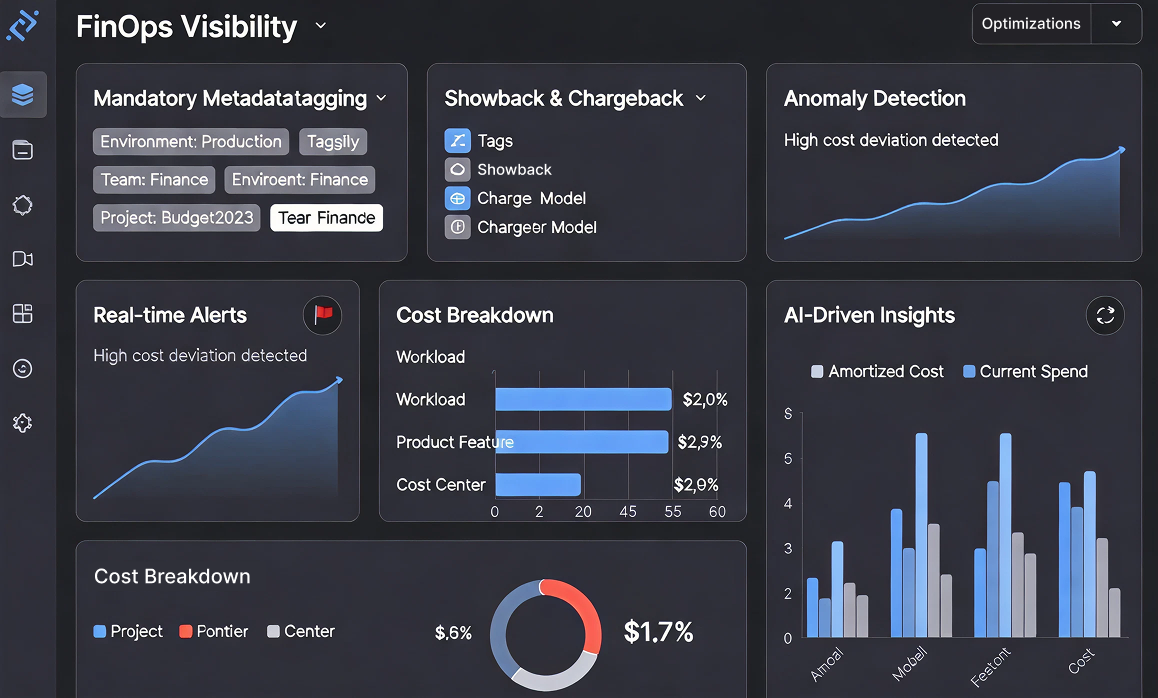
This is why FinOps (Cloud Financial Management) has transitioned from an IT buzzword to a mandatory fiscal strategy for the C-suite.
What is FinOps in Cloud Data Platforms?
FinOps is a cultural and operational discipline that brings financial accountability to the variable spend model of the cloud. While traditional FinOps focuses on general infrastructure (like virtual machines, storage buckets), Data FinOps is a specialized subset tailored to the nuances of data platforms.
Unlike fixed-cost servers, cloud data platforms operate on consumption-based models. You pay for the reservations made, time a query runs, the terabytes of data scanned, and the tokens processed by an LLM.
Strategic FinOps Framework for 2026
This guide outlines the essential pillars for navigating the complex reality of cloud financial management for data platforms:
- Granular Attribution:
Providing real-time visibility into who is spending what. This involves granular tagging and mapping cloud costs to specific departments, products, or even individual AI models. - Engineering Accountability: Bridging the gap between DevOps speed and fiscal responsibility.
- Automated Optimization:
This includes identifying "zombie" data pipelines that run but deliver no value, and leveraging "Reserved Instances" or "Capacity Commitments" to lower unit costs. - Dynamic Budgeting:
Replacing static annual forecasts with rolling, consumption-aware financial models.
By treating cloud data spend with the same rigor as any major operating expense, enterprises can stop managing "waste" and start managing innovation.
Why Does Cloud Data Platform Management Need FinOps?
In 2026, the data landscape is no longer static. Today, data is a living ecosystem, which is constantly being moved, transformed, and queried across global regions. Without a FinOps framework, organizations fall victim to the "Cloud Paradox": the more successful and data-driven your company becomes, the more your cloud consumption scales, eventually eroding the very profit margins that data was intended to improve.
The Rise of "Black Box" Consumption
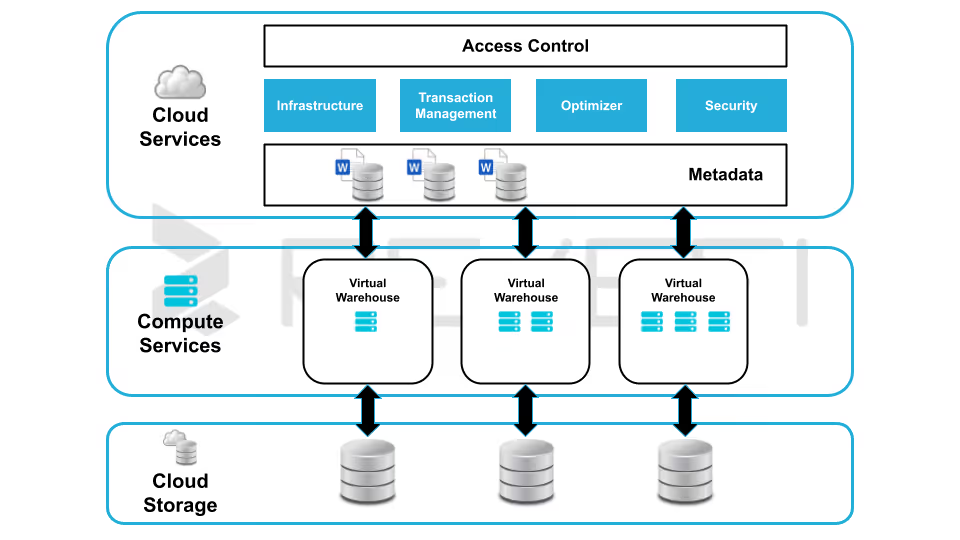
Modern data platforms like Snowflake, Databricks, AWS Redshift and Google BigQuery are engineered for high-velocity innovation. They are "frictionless" by design, allowing engineers and data scientists to spin up massive compute clusters or "virtual warehouses" with a single click.
However, this ease of use creates a massive financial blind spot. Without FinOps-driven guardrails (such as auto-scaling limits, automated suspension of idle resources, and query-level cost attribution) a single inefficient SQL query (like a cross-join on a multi-terabyte dataset) or an unoptimized data ingestion job can trigger a "spending storm." In many cases, these errors run for days, racking up thousands of dollars in costs before the Data or Finance team even sees a preliminary invoice. FinOps provides the "lighting" for this black box, ensuring that technical autonomy does not lead to financial catastrophe.
Managing the Multi-Cloud Reality
Enterprise-grade data strategies in 2026 tend to be multi-cloud. Companies distribute workloads across a plethora of data cloud platforms such as Snowflake, Databricks, AWS RedShift, Azure, and the Google Cloud Platform (which includes BigQuery) to maintain leverage and avoid vendor lock-in.
However, every provider has a different billing dialect, varying discount structures (Savings Plans vs. Reserved Instances), and unique "egress" fees for moving data.
FinOps introduces a standardized language for this complexity. By utilizing the FOCUS (FinOps Open Cost & Usage Specification), FinOps practitioners can normalize data across disparate providers. This gives the Office of the CFO a "single pane of glass" view to compare the cost-efficiency of a Databricks cluster on Azure versus a similar workload on AWS, enabling data-driven negotiations with cloud vendors.
For a more detailed, point-by-point analysis of how data cloud platforms bill customers of all types and sizes, check out Revefi’s pricing guides listed below (2026 updated).
Why CFOs Should Care About FinOps for Cloud Data Platforms
For a modern CFO, FinOps is a strategic lever to help realize and maximize the Return on Investment (ROI) of the entire organization’s digital estate!
"From being a mere write-off, a company's cloud data platform bill is now often the second or third largest line item on the P&L in 2026," where managing it requires the same rigor as managing payroll or debt.
CEO & Co-founder

Moving from “Fire-Fighting” to a more Proactive Approach
Traditional accounting is inherently reactive. You receive a data platform bill 15 days after the month ends and perform a "financial autopsy" to figure out why you overspent. By then, the capital is gone, and you’re officially one-step behind!
FinOps shifts the paradigm to proactive management through real-time observability. While most modern FinOps platforms use AI to monitor spending patterns in real-time and alert teams when things are going wrong, real ROI is derived only if there is a “real-time” pathway to remediation.
If a data pipeline suddenly spikes in cost due to a configuration error, traditional systems trigger an anomaly alert. However, this would still require the CFO’s team to partner with Engineering for discovery and remediation. In an era where “Time is Money”, this is not a viable solution.
To effectively stop the bleeding before it impacts the quarterly bottom line, CFOs are now starting to lean on fully-autonomous observability solutions that have not only identified the problem, but also recommended solutions for immediate remediation.
By cutting down the Mean-Time-To-Resolution (MTTR) from days to minutes, business leaders begin to see tangible ROI.
Precision Predictability in a Volatile Market
Public markets and private boards position predictability as their first benchmark for tracking success metrics. Yet, the consumption-based nature of cloud platforms makes this traditional, static annual budgeting practice obsolete.
FinOps enables the transition to algorithmic forecasting. By analyzing real-time netadata and historical metadata (such as seasonal data surges during Black Friday, end-of-quarter reporting cycles, or AI training phases) FinOps tools can generate rolling forecasts with up to 95% accuracy. This allows the CFO to provide confident guidance to stakeholders, ensuring that there are no "surprises" when it comes to technology spend.
Protecting Gross Margins via Unit Economics
In a digital-first economy, cloud costs are a direct component of the Cost of Goods Sold (COGS). If the cost of the data processing required to serve a customer grows faster than the revenue that customer generates, your business is scaling toward insolvency.
FinOps empowers the CFO to speak in terms of Unit Economics. Rather than looking at a monolithic cloud bill to guess where your business units are burning cash on cloud data spend, you can break it down into business-centric metrics:
By tying cloud spend directly to business outcomes, the CFO ensures that the company’s digital transformation remains fundamentally profitable, protecting gross margins even as data volumes explode.
How FinOps Aligns with the CFO’s Priorities
What’s surprising is that the strategic objectives of a CFO in 2026 perfectly mirrored the outcomes of a successful FinOps practice. The table below shows you exactly how:
The focus for 2026 is shifting from simple cost-cutting to Value-Based Cloud Governance.
Top 5 Strategic Pitfalls in Data FinOps Governance
To achieve sustainable cloud ROI, leadership must move beyond traditional IT procurement mindsets. Here are the most common traps that undermine modern data platform efficiency.
1. Misclassifying Data Platform Spend as Traditional IT Overhead
Traditional IT cost management relies on centralized, long-term capacity planning. In contrast, data platform consumption is decentralized and volatile, driven by hundreds of real-time decisions made by engineers.
- The Risk:
Applying "IT muscle memory" creates bureaucratic bottlenecks that stifle innovation and encourage teams to bypass official channels. - The Fix:
Shift to an agile consumption model that mirrors the speed of cloud-native development.
2. Creating Centralized Teams Without Distributed Accountability
A central FinOps office is a valuable steering committee, but it shouldn't be a silo. If the engineers and product owners (actual "spenders") lack visibility and skin in the game, the FinOps team becomes a passive reporting bureau rather than an engine for change. Push cost transparency and accountability down to the individual contributor level.
3. Treating Tagging as a One-Time Remediation Project
Metadata tagging is often treated as a "cleanup project" that happens once a year. These initiatives usually decay within 90 days as new workloads enter the ecosystem. Tagging is a continuous operational practice. It must be integrated into the deployment pipeline (CI/CD) so that no asset is provisioned without an owner or cost center.
4. Misaligning Optimization Efforts with Spend Impact
Teams often spend weeks optimizing storage costs because they are easy to identify, even though storage only accounts for about 5% of the total invoice. Use a Pareto Analysis to ensure your engineering resources are focused on the largest cost drivers (typically compute and data egress) rather than low-impact line items.
5. Equating Success with Lower Total Spending
The most sophisticated FinOps organizations do not necessarily have the smallest bills; they have the most defensible unit economics. Success is defined by spending intentionally on high-margin workloads that drive enterprise value, even if that means the absolute spend increases.
Conclusion: The CFO as a Strategic Cloud Partner
In 2026, the role of the CFO has evolved from a "gatekeeper of funds" to a "navigator of value." By embracing FinOps, you transition the Cloud Data Platform from a black box of expenses into a transparent, high-yield asset.
The path forward is clear: Establish visibility, automate your rate optimization, and tie every cent of cloud spend to a tangible business outcome. In the high-stakes economy of 2026, those who master the unit economics of the cloud will be the ones who lead their industries.
By embracing FinOps, you transition from being a "cost center" to a strategic partner who understands exactly how data spend converts into business value. You aren't just paying the cloud bill; you are investing in the competitive advantage of your enterprise.

