I’ve spent my entire career in the trenches with complex data and ML systems, from conducting database research at Microsoft Research and engineering infrastructure at Google, to co-founding ThoughtSpot and starting Revefi. A couple of years ago, I shared a blueprint on this blog for shaping a modern enterprise data strategy. It offered solid advice for its time. Today, however, it is entirely outdated.
I will be direct: an enterprise data strategy that fails to account for your enterprise AI strategy is no longer just a missing piece. It is a massive corporate liability.
Back in 2024, organizations were asking how to manage, govern, and extract value from their datasets. In 2026, your data infrastructure and generative AI models may share or compete for the same budget, security boundaries, and ROI scrutiny from the board. Planning them in isolation is a recipe for failure, because when one falters, both collapse.
This updated guide for 2026 retains the ultimate objective: transforming your enterprise data into a defensible competitive moat. However, it is fully re-architected for a market where autonomous AI agents run in live production, token economics directly impacts operating expenses, and "AI experimentation" is no longer accepted as a justification for unmonitored spend.
Core Takeaways for Executive Leadership
- Convergence is Mandatory:
The separation between your data and AI strategy 2026 roadmap has vanished. Data quality, governance, spend optimization, and reliability must operate as a unified ecosystem. - Actionability Replaces Visibility:
Traditional static dashboards that merely report infrastructure failures are obsolete. The 2026 standard belongs to autonomous systems that actively resolve issues. - AI FinOps is Non-Negotiable:
Unmonitored token consumption can consume annual IT budgets in days. Without granular cost attribution tied to business outcomes, proving AI ROI is impossible. - Data Integrity Dictates AI Success:
AI hallucinations are almost universally downstream symptoms of pre-existing data pipeline defects. - Autonomous Operations Are Here:
AI agents acting as digital DBAs have transitioned from theoretical concepts to live production environments. Strategic roadmaps must assume autonomous execution, not debate it.
Key Market Shifts: What Changed Since 2024?
While foundational pillars like data governance, quality, integration, analytics, and security remain critical, three structural shifts have fundamentally transformed how enterprise technology leaders must approach execution:
1. AI Scaling Exposed Massive Budget Risks
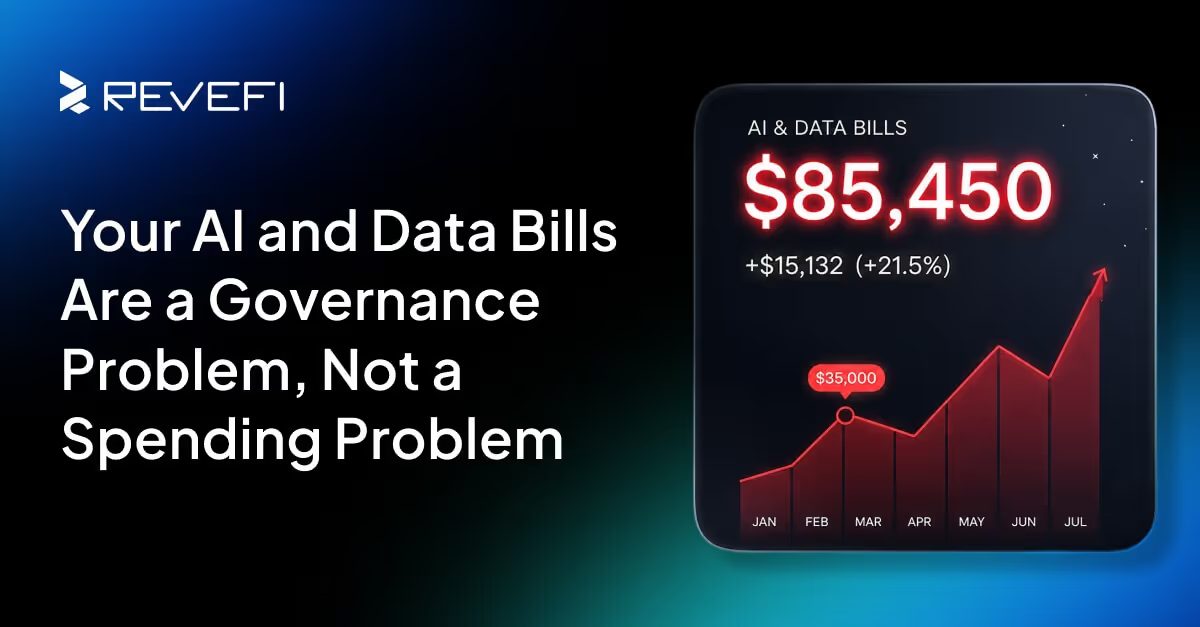
The rapid push to integrate agentic workflows across operations resulted in hyper-scaling resource usage. Enterprise AI agents can consume billions of tokens in minutes. In one real-world instance at a Fortune 500 company, an unmonitored user triggered $76,000 in unexpected token charges on a single project. Because every generative model relies entirely on underlying data stores, an unoptimized AI workload can compromise both your AI and cloud data platform budgets simultaneously.
2. The Evolution from Analytics Dashboards to Automated Remediation
For years, FinOps and data observability platforms focused solely on visibility, generating reports, cost breakdowns, and charts showing where capital was spent. Modern enterprises no longer need another dashboard confirming system issues; they require intelligent automation that fixes root causes. Closing this gap represents the single largest operational shift in enterprise software today.
3. Algorithmic Models Were the Easy Part; Management is the True Hurdle
Designing base AI agents to execute tasks is relatively straightforward. The true challenge lies in the underlying orchestration layer: tracking resource utilization, verifying accuracy, controlling cost overhead, and measuring productivity. Before deploying autonomous tools (such as an AI-driven DBA to manage cloud environments like Snowflake or Databricks) enterprises must first implement an operational monitoring and governance framework.
What an enterprise data strategy means in 2026: Defining the Modern Enterprise Data + AI Strategy
An effective enterprise data strategy is a comprehensive framework that governs how an organization captures, protects, optimizes, and leverages its digital assets to fuel business growth.
However, in 2026, the definition of "data assets" expands to include LLMs, vector database pipelines, autonomous agents, and token consumption metrics. A strategy restricted purely to traditional data warehouses ignores the most expensive and volatile half of the modern enterprise tech stack.
Here’s the test I give data leaders: can you answer, today, what your total “AI spend” was last week, which department drove it, which of it was wasted, and what business outcome it produced? If the answer is no, you don’t have a data and AI strategy. You have a data strategy and an AI hope.
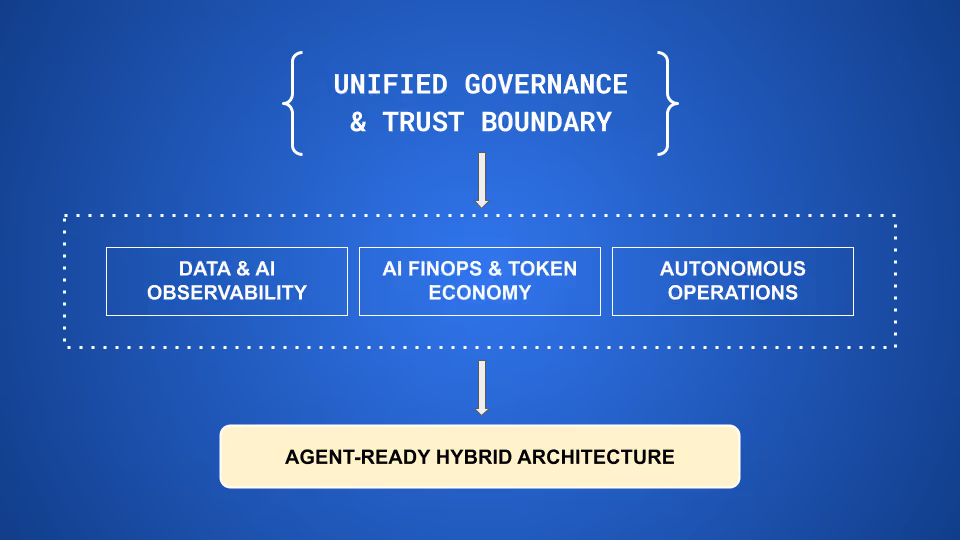
The 7 Core Pillars of a 2026 Enterprise Data + AI Framework
1. Unified Data & AI Governance
Legacy governance models maintained strict silos between data policies and machine learning teams. Modern governance standardizes access control, data lineage, model usage parameters, and agent permission levels under a single structure. Treating AI oversight as a separate initiative creates shadow AI operations, replicating the security vulnerabilities of shadow IT.
2. Integrated Data Quality & Observability
“Garbage-in” results in automated, high-speed “errors-out.” Every fine-tuned LLM, Retrieval-Augmented Generation (RAG) architecture, and agentic workflow inherits the flaws hidden within source data pipelines. Automated, real-time monitoring of schema shifts, data freshness, and pipeline anomalies is now a baseline requirement to ensure AI outputs remain accurate and trustworthy.
3. End-to-End AI Observability
While standard data infrastructure is usually monitored, the AI layer (comprising prompt sequences, LLM calls, latency variations, and token usage) frequently operates inside a black box. AI observability addresses this gap by tracing transactions end-to-end, identifying bottlenecks, model degradation, or cost spikes before end users are impacted.
4. Advanced AI FinOps and Token Economics
Cloud spend management is a critical enterprise priority. Applying AI FinOps principles alongside targeted token economics ensures AI investments remain tied to value rather than unconstrained utilization. By establishing per-user cost allocation, detecting cost anomalies early, and flagging redundant model queries, organizations prevent token expenditures from ballooning unexpectedly.
5. Autonomous Infrastructure Operations
Manual database administration cannot keep pace with modern, multi-cloud data estates. Next-generation platforms leverage native AI agents to monitor, tune, and optimize environments like Snowflake and Databricks continuously. These autonomous systems analyze workload patterns, generate optimization strategies, and execute cost-reduction actions under predefined administrative controls.
6. Agent-Ready System Architecture
Enterprise architectures must serve two distinct internal clients: human business analysts reading dashboards, and autonomous agents executing operational workflows. System design and platform selection criteria must evaluate API responsiveness, query scan costs, and supporting capabilities for both analytical reporting and real-time inference.
7. Modernized Security, Risk & Compliance Boundaries
Standard security mandates (such as end-to-end encryption, strict role-based access controls, and compliance logging) must expand to cover AI execution boundaries. Organizations must establish clear rules detailing what data models can process, which actions agents can execute independently, and complete audit logs for automated decisions.
Suggested Implementation Roadmap
- Audit Your Entire Data and AI Ecosystem:
Catalog all active data assets, pipelines, hosted models, shadow AI tools, and production agents. - Define Clear Financial Metrics for AI ROI:
Avoid vague objectives like "enhancing productivity." Tie every technical initiative to a concrete KPI (such as operational cost reductions, time saved, or direct revenue attribution). - Deploy Unified Governance Controls:
Institute a single governance board responsible for managing both data access privileges and AI model permissions. - Implement Full-Stack Observability Early:
Establish end-to-end visibility across data pipelines, infrastructure usage, and LLM query logs before scaling workloads enterprise-wide. - Establish AI FinOps Guardrails:
Set automated alerting thresholds and isolate cost metrics by business unit, workload, and user to enforce accountability for token spend. - Integrate Progressive Autonomous Automation:
Move systematically from basic automated performance monitoring to human-in-the-loop autonomous execution. - Iterate Based on Measurable Business Impact:
Conduct quarterly reviews to measure platform performance against target outcomes. Reallocate capital away from underperforming pilots into high-performing deployments.
The mistakes I keep seeing
Four failure patterns come up in nearly every conversation I have with data leaders. Treating AI strategy and data strategy as separate documents owned by separate teams. Scaling AI usage before establishing cost governance, then discovering the burn rate at invoice time. Buying dashboards when the problem is action, adding a fifth reporting tool instead of one system that fixes what it finds. And underinvesting in data quality while expecting AI built on that data to be trustworthy. Each of these is cheaper to prevent in your strategy than to fix in production.
Common Pitfalls to Avoid
- Operating Data and AI in Organizational Silos:
Maintaining separate strategies managed by isolated teams leads to redundant investments and security blind spots. - Scaling AI Workloads Without Cost Management:
Deploying generative tools without AI FinOps governance leads to severe invoice surprises. - Investing in Reporting Tools Over Automated Remediation:
Purchasing additional visualization dashboards rather than platforms capable of automatically resolving data issues slows down operational efficiency. - Ignoring Baseline Data Quality:
Expecting advanced LLMs or RAG applications to yield accurate results on top of unmanaged, poor-quality data sources leads to failing projects.
Where Revefi fits
We built the Revefi platform and Raden, our AI agent, for exactly this convergence: one system that governs cost, quality, and reliability across data, AI, and agents. Data observability and FinOps proven at the data layer, where customers cut spend 30–70%; AI observability and token economics governing the new layer on top; and an AI DBA that turns findings into executed fixes, 24×7, with your approval in the loop. Zero-touch setup, results in minutes. The case studies tell the story better than I can.
Wrapping it up
Two years ago, the closing advice in this guide was to treat data as a strategic asset. That advice stands even for AI. What’s new is urgency: AI has collapsed the distance between a good data strategy and a visible business result, in both directions. Get it right and the ROI shows up in quarters, not years. Get it wrong and the costs show up in weeks.
Unlocking value is not a one-time effort; it’s an ongoing journey. But 2026 is the year the journey stops being optional.
Try the Revefi sandbox. In five minutes, you’ll see your data and AI spend, quality issues, and optimization opportunities in one place.