AI FinOps, also known as FinOps for AI, is the financial management discipline of measuring, attributing, forecasting, and optimizing the costs of artificial intelligence models, autonomous agents, and supporting data platforms.
By connecting compute resources and token expenses directly to measurable business outcomes, AI FinOps ensures that enterprise AI investments generate real return on investment.
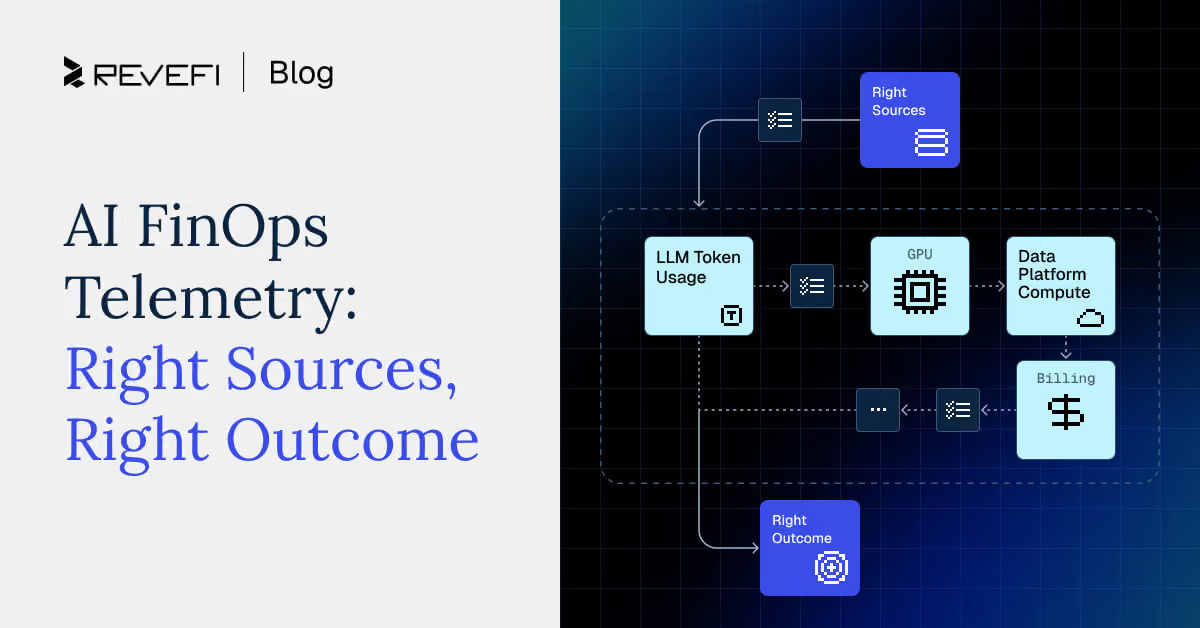
Modern enterprise AI spending accelerates faster than legacy cloud cost management tools can track. Because autonomous agents independently invoke foundation models, external APIs, and data pipelines, a single user prompt can exhaust a monthly department budget in hours. To maintain financial governance, AI FinOps answers three core questions for every AI workload.
- What did it cost? Accounting for total expenses across every model provider, autonomous agent, end user, and data platform involved in a transaction.
- Did it work? Verifying whether the generated output met enterprise accuracy, latency, and quality standards.
- Was it worth it? Determining if the inference and compute spend delivered a quantifiable business outcome or revenue impact.
Why AI Breaks Traditional Cloud FinOps
Traditional Cloud FinOps was designed for human-provisioned infrastructure with predictable, linear billing cycles. Enterprise AI workloads disrupt both of those foundational assumptions in five critical ways.
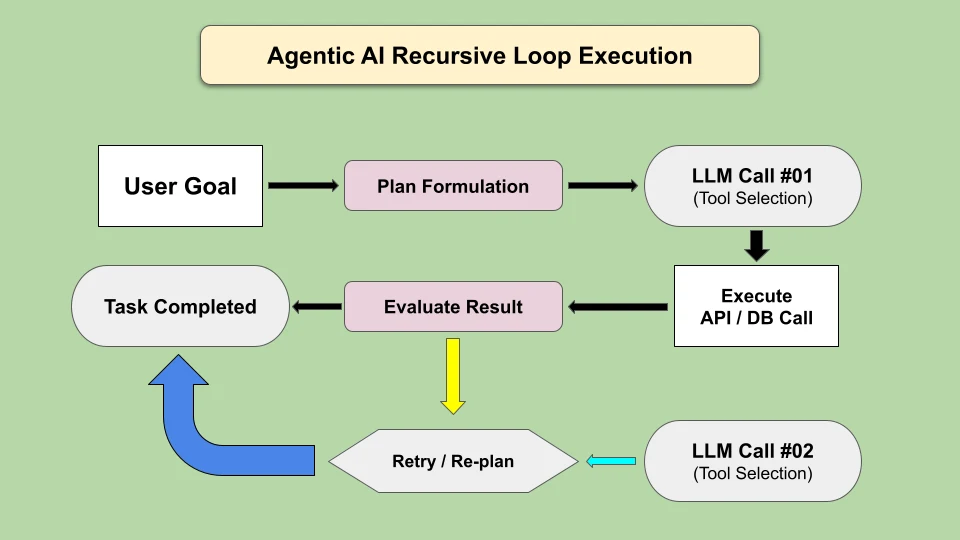
- Consumption is autonomous. A single user prompt can trigger cascading subagents, external tool calls, and multi-step reasoning loops without human approval at each stage.
- Coding agents run everywhere. Developers across the organization deploy AI coding assistants that repeatedly execute redundant queries and context lookups across separate sessions.
- Pricing models are fragmented. Enterprises must reconcile token usage, platform credits, software seats, GPU compute hours, and data warehouse credits across disconnected vendor invoices.
- Data platform costs hide inside AI workflows. Retrieval-augmented generation (RAG), vector embeddings, and context-building database queries inflate data warehouse bills rather than appearing as direct model expenses.
- Billing is delayed. Vendor invoices often lag behind real-time consumption by days or weeks, surfacing financial overruns long after an unmonitored agent loop has completed.
Consequently, annual enterprise AI budgets frequently deplete within a single quarter, leaving finance and engineering leaders unable to pinpoint which team, product, or use case drove the expenditure.
The 10 capabilities of AI FinOps
The capabilities fall into five stages: View, Understand, Control, Optimize and Proof. Results from Proof reset forecasts, budgets and policies, so each cycle funds what works.
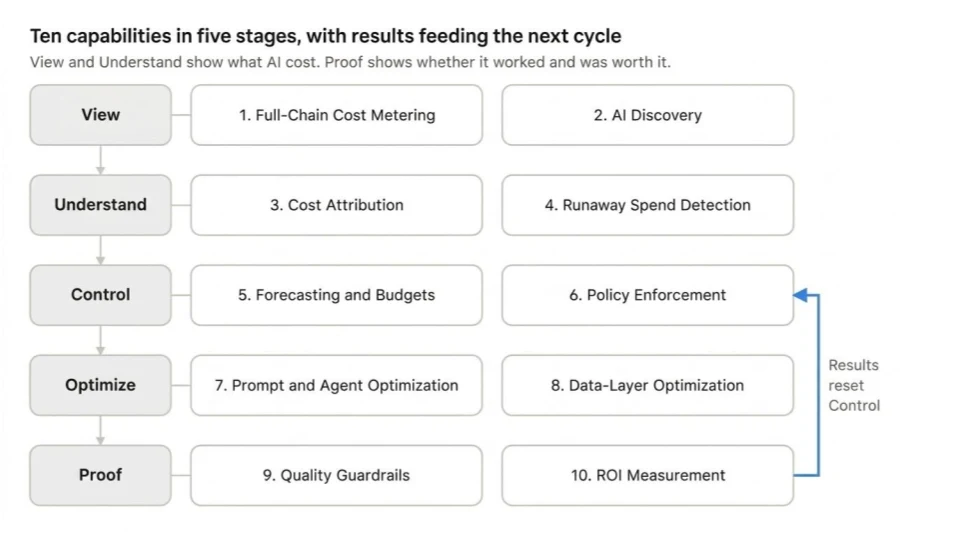
Given below are the 10 most crucial capabilities an AI FinOps solution must have, in order to be effective in today’s era of AI-powered solutions, systems, and architectures:
1. Full-Chain Cost Metering (View)
Track every expense an AI action generates in real time, spanning from the data platform that builds context to the foundation model that responds and the autonomous agent that orchestrates the workflow. Normalize tokens, platform credits, user seats, GPU compute hours, and data warehouse usage into a unified financial model, as raw token counts alone significantly understate total AI costs.
2. AI Discovery (View)
Maintain an automated, continuous inventory of every foundation model, AI application, API key, and autonomous agent operating across the enterprise, including shadow AI adopted without central IT approval. Every untracked deployment represents unattributed, unbudgeted, and ungoverned expenditure.
3. Cost Attribution (Understand)
Map every dollar spent directly to the specific end user, engineering team, autonomous agent, use case, product line, and customer that initiated the request. Because vendor invoices group charges by model rather than business function, granular attribution is essential for finance teams to execute accurate chargebacks and for product leaders to calculate feature-level margins.
4. Runaway Spend Detection (Understand)
Identify infinite reasoning loops, sudden token surges, and oversized context windows within minutes, automatically alerting the system owner with the root cause. A malfunctioning agent can accumulate tens of thousands of dollars in compute fees overnight, whereas waiting for a month-end billing statement turns a preventable incident into a major financial write-off.
5. Forecasting and Budgets (Control)
Project future AI model and data platform expenditures using historical consumption trends, planned feature launches, and statistical confidence intervals. Establish dynamic budgets per team, agent, and business use case grounded in predictive data rather than outdated annual estimates.
6. Policy Enforcement (Control)
Translate financial budgets into automated guardrails that operate directly inside the execution path, applying spend caps, rate throttles, and model routing restrictions before costs are incurred. Generate governance rules from observed usage patterns and enforce them seamlessly through your existing AI gateway.
7. Prompt and Agent Optimization (Optimize)
Reduce the total tokens and conversational turns AI workloads consume by compressing system prompts, pruning unnecessary context, and eliminating redundant tasks across autonomous workflows and coding assistants like Claude Code. Deploy shared prompt templates and version-controlled scripts across engineering teams so routine tasks run reliably on smaller, lower-cost models.
8. Data-Layer Optimization (Optimize)
Streamline the data warehouse queries, ingestion pipelines, and retrieval architectures that supply context to AI applications on platforms like Snowflake, Databricks, and BigQuery. Data infrastructure represents the hidden second bill of enterprise AI, and optimizing the model layer alone leaves these substantial compute costs untouched.
9. Quality Guardrails (Proof)
Validate every cost optimization and policy enforcement rule against output accuracy, task completion rates, and failure metrics. Switching to a smaller model or aggressive prompt compression can silently degrade response quality, turning apparent compute savings into expensive human rework.
10. ROI Measurement (Proof)
Connect the financial cost of every AI transaction directly to a tangible business metric, such as cost per resolved support ticket, per automated workflow, or per strategic decision. Report expenditure categorized by business outcome, department, and wasted versus optimized spend, feeding those insights directly into the next enterprise budget cycle.
Get Revefi’s Full AI FinOps Checklist
The full white paper, titled ‘The AI FinOps Checklist: 10 Must-Have Capabilities for Enterprise AI’ introduces in great detail what efficiency looks like for each capability, and how enterprises can enable themselves with the ability to score AI FinOps solutions based on the established capabilities.
Download The AI FinOps Checklist →
About Revefi
Revefi is an enterprise AI and data control plane that delivers all 10 recommended AI FinOps capabilities in one platform, across model, agent and data platform spend, with Revefi's AI agent running the work continuously.