The modern enterprise data stack has transitioned away from the constraints of isolated, monolithic relational database management systems (RDBMS).
Modern data architecture is fundamentally distributed. It relies on highly integrated, multi-cloud analytical ecosystems that seamlessly blend:
- Cloud data warehouses
- Decoupled object-storage lakehouses
- Massive Parallel Processing (MPP) query engines
In other words, “data” is no longer confined to a single transactional database.
Instead, it spans multi-cloud data warehouses, lakehouses, and massive analytical engines. Managing these environments (specifically market leaders like Snowflake, Databricks, and Google BigQuery) has traditionally fallen on the shoulders of human Database Administrators (DBAs) and Data Engineers.
However, as enterprise data volumes routinely scale into the petabyte range (1 PB = 1000 TB = 1 Million GB), relying on manual optimization for cloud data platforms is both inefficient and impractical.
A human DBA faces both cognitive and operational bottlenecks when managing these modern, automated workloads. It is structurally impossible for a human operator to perform:
- Real-time telemetry analysis on millions of highly complex
- Distributed query execution graphs
- Accurately forecast non-linear compute cost trajectories across fluctuating serverless credit models
- Continuously compute and re-align optimal micro-partition clustering keys across tens of thousands of dynamic tables simultaneously
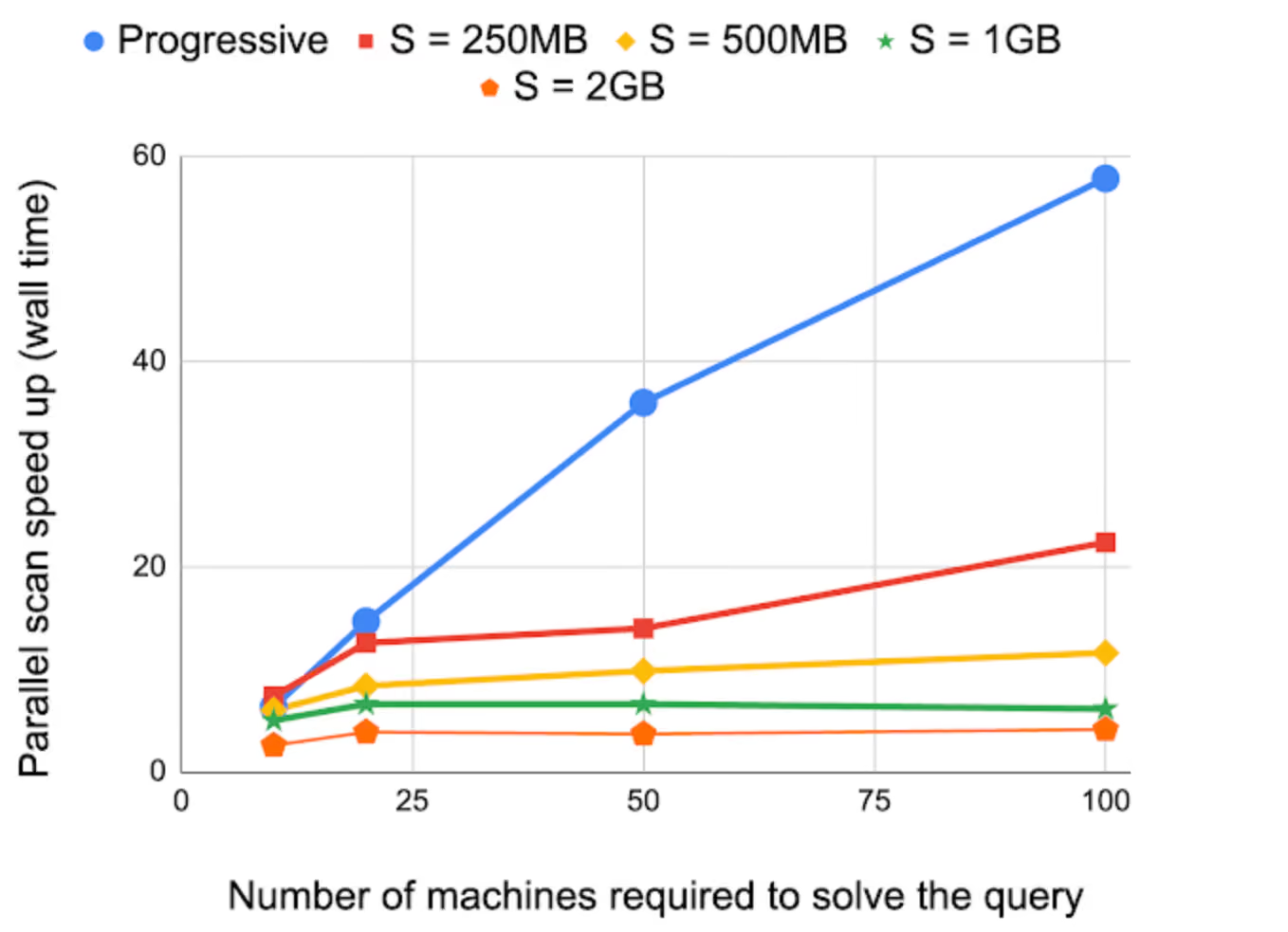
"Spending on database management software (DBMS) with embedded generative AI capabilities will grow from $65 billion in 2025 to $218 billion by 2028."

Source: Gartner Insights
Hence, the shift toward autonomous database administration was inevitable!
Driven by advancements in Large Language Models (LLMs), agentic workflows, and machine learning (ML), AI DBAs are transitioning from passive monitoring alerts to autonomous, self-healing, and self-optimizing agents.
This blog explores how an AI DBA operates across Snowflake, Databricks, and Google BigQuery, the underlying architecture that powers them, and how they can be used to optimize cost, performance, and data security.
Defining the AI Database Administrator (AI DBA)
An AI DBA is an autonomous agentic AI system that leverages AI/ML algorithms, Deep Learning, and LLMs to perform the traditional duties of a database administrator. Unlike legacy APM (Application Performance Monitoring) tools that simply alert a human when a threshold is breached, an AI DBA analyzes metadata, predicts systemic failures, generates optimized code, and executes remediations.
Core Capabilities of an AI DBA
- Predictive Workload Management:
Forecasting compute spikes and proactively scaling resources. - Autonomous Query Tuning:
Analyzing execution plans and rewriting inefficient SQL or PySpark code. - Dynamic Storage Optimization:
Managing partitioning, clustering, and micro-partitioning without human intervention. - FinOps & Cost Governance:
Identifying runaway queries, idle warehouses, and unutilized storage to minimize cloud spend. - Security & Compliance Guardrails:
Detecting anomalous access patterns and identifying exposed Sensitive Personal Information (SPI/PII).
The Architectural Framework of an AI DBA
To understand how an AI DBA manages multi-cloud environments, we must look at its underlying agentic architecture. An AI DBA does not just run static scripts; it operates as a continuous closed-loop feedback system.
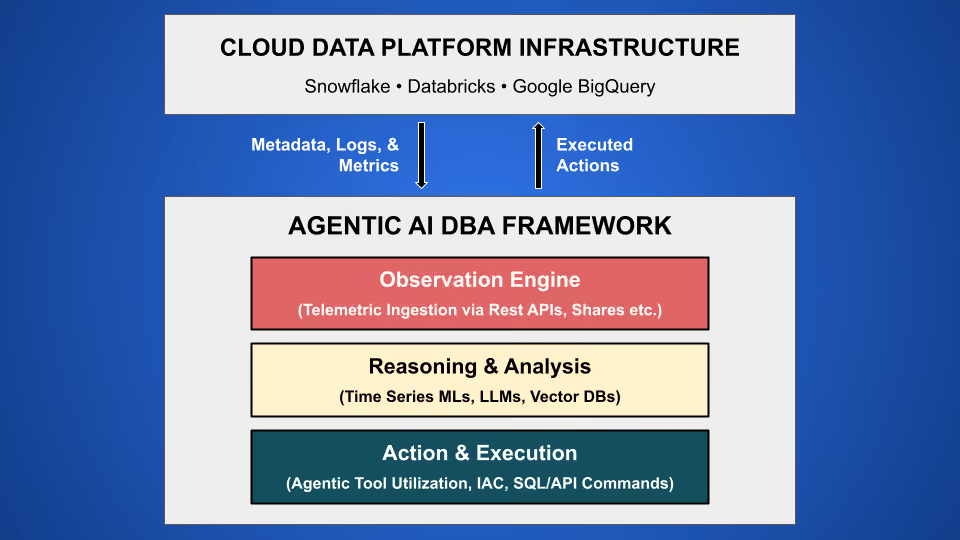
Phase 1: The Observation Engine (Telemetry Ingestion)
The AI DBA connects to the target data platform (such as Snowflake, Databricks, or Google BigQuery) via secure REST APIs, native drivers (JDBC/ODBC), or shared metadata layers (e.g., Snowflake Share, Databricks Unity Catalog, Google Cloud Logging).
As a result, it continuously ingests:
- Query History & Execution Profiles:
Raw SQL/Spark syntax, compile times, execution times, and target tables. - System Metrics:
CPU utilization, memory spilling, local/remote storage I/O, and queue times. - Storage Metadata:
Table sizes, file counts, clustering depth, and partition statistics. - Access Logs:
User identities, IP addresses, client applications, and data access paths.
Phase 02: Reasoning & Analysis
Collected telemetry is processed through a hybrid AI engine:
- Time-Series ML Models:
Proprietary Algorithms or LSTM (Long Short-Term Memory) networks analyze historical resource consumption to forecast future workloads. - LLMs & Vector Databases:
The AI DBA uses Large Language Models (LLMs) paired with Retrieval-Augmented Generation (RAG) to understand complex SQL syntax, parse error logs, and reference platform-specific documentation. - Heuristic & Cost Models:
Specialized financial algorithms calculate the impact of poorly written queries, or data ingestion (ETL/ELT) practices to predict the exact ROI of an optimization.
Phase 03: Action & Execution
Once a decision is reached, the AI DBA moves from analysis to execution using an agentic framework (such as LangGraph or AutoGen). It leverages pre-built toolkits to interact with the target data platform:
- Read-Only Mode:
The AI surfaces recommendations via a dashboard, Slack, or a Pull Request in a CI/CD pipeline. - Autonomous Mode:
The AI executes commands directly via the platform’s CLI or API, such as altering virtual warehouse sizes, changing a clustering key, revoking permissions to run heavy-set actions, or killing rogue transactions.
How Does the AI DBA Work for Snowflake?
Snowflake’s architecture separates compute (Virtual Warehouses) from centralized storage. An AI DBA optimizing Snowflake focuses heavily on virtual warehouse management, micro-partitioning, and utilizing Snowflake's native AI features.
Optimizing Snowflake Compute & Storage
Virtual Warehouse Tuning
Snowflake warehouses scale horizontally (Multi-cluster) and vertically (Standard to 6X-Large). Humans often misconfigure scaling policies, leading to high queue times or excessive costs. An AI DBA continuously monitors LOGIN_HISTORY, QUERY_HISTORY, and WAREHOUSE_LOAD_HISTORY.
If the AI sees that queries are backing up and waiting for resources, it automatically shifts the system into a higher gear to handle the rush. On the flip side, if it notices that your virtual computing power is sitting idle and wasting money, it will automatically shrink the system down to a smaller size or turn it off sooner when it's not being used.
Automatic Micro-Partitioning and Search Optimization Service (SOS)
Snowflake stores data in encrypted micro-partitions. Over time, as DML operations occur, data natural clustering degrades.
The AI DBA monitors the SYSTEM$CLUSTERING_INFORMATION function. When clustering depth exceeds an optimal threshold, the AI configures a Cluster Key for the table, or it selectively enables the Search Optimization Service (SOS) for point-lookups, balancing the SOS maintenance cost against query performance gains.
Integration with Snowflake Native AI (Cortex AI)
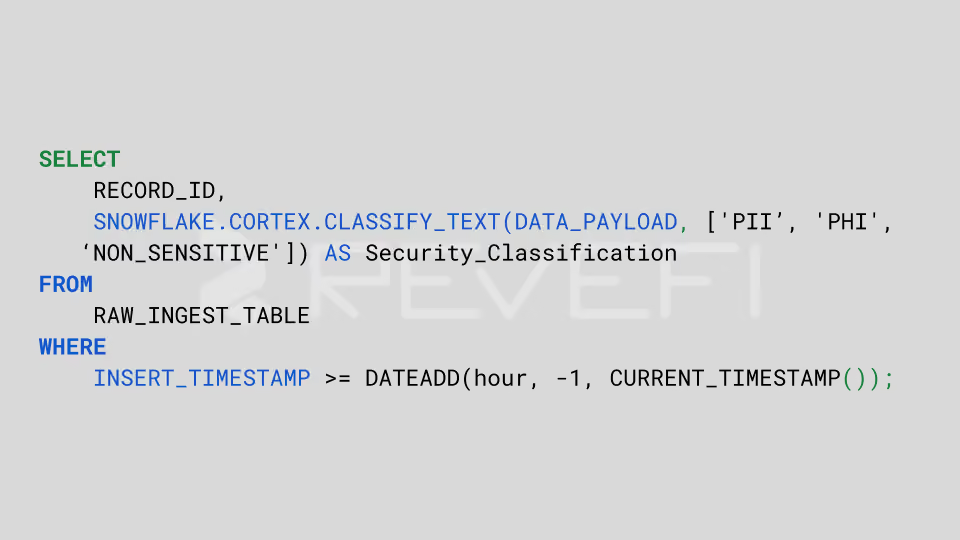
Modern AI DBAs leverage Snowflake’s built-in Cortex AI functions to execute tasks within the database boundary.
- The AI DBA can deploy lightweight classification models (such as SNOWFLAKE.CORTEX.PARSE_TEXT_COLUMNS) to scan columns for sensitive data without extracting the data outside the Snowflake security perimeter.
- The AI DBA utilizes Cortex LLMs (llama3-70b, mistral-large) directly within SQL queries to automatically generate data masking policies based on natural language compliance requirements.
How Does the AI DBA Work for Databricks?
Databricks operates on a Lakehouse architecture powered by Delta Lake and the Spark engine. Optimization in Databricks requires an intimate understanding of distributed computing, memory allocation, and the Unity Catalog governance layer.
Optimizing the Spark Engine & Delta Lake
Delta Tuning (Liquid Clustering & Predictive Optimization)
Traditionally, Databricks required manual OPTIMIZE and Z-ORDER BY commands to maintain fast query times. An AI DBA interfaces directly with Databricks' Predictive Optimization engine. It monitors file fragmentation and data skipping metrics.
If a table is frequently filtered by a specific column combination, the AI DBA triggers Liquid Clustering, dynamically adjusting data layout without requiring a rigid partitioning strategy. It ensures that file sizes remain close to the optimal 1GB target, preventing the "small file problem" that degrades Spark performance.
Spark Compute Optimization (Serverless & Photon)
The AI DBA evaluates the workload execution plans passing through the Photon engine. If it detects heavy memory spilling to disk (spillToDisk), it dynamically alters the Spark configuration parameters:
- Increases spark.sql.shuffle.partitions to break data into smaller, manageable chunks
- Adjusts spark.executor.memory allocation
- Recommends moving from classic interactive clusters to Databricks Serverless SQL Warehouses, ensuring compute resources scale down instantly to zero seconds after a query finishes
Integration with Unity Catalog & Mosaic AI
Unity Catalog provides centralized governance across the Databricks Lakehouse. The AI DBA acts as an autonomous auditor within Unity Catalog:
- Lineage Analysis:
It parses the end-to-end data lineage graph to find abandoned tables ("dark data") that are consuming storage but haven't been queried in months. - Privilege Auditing:
It flags over-privileged identities and suggests Least-Privilege Access control lists (ACLs) based on actual usage telemetry. - Vector Search & System Tables:
The AI DBA queries Databricks System Tables (e.g., system.billing.usage, system.query.history) and feeds this structured data into Databricks Vector Search, enabling a localized RAG agent to answer precise troubleshooting questions like, "Why did the ETL pipeline fail at 2:45 PM yesterday?"
How Does the AI DBA Work for Google BigQuery?
Google BigQuery is a fully serverless, highly scalable data warehouse. Because compute resources (Slots) are decoupled entirely and managed by Google, optimization inside BigQuery centers around slot allocation management, partition/cluster design, and cost prevention.
Optimizing BigQuery Slots & Cost Control
Slot Capacity Management
BigQuery offers On-Demand pricing (per terabyte scanned) and Capacity pricing (purchasing dedicated Slots). An AI DBA continuously calculates the tipping point between these models.
By analyzing the INFORMATION_SCHEMA.JOBS_BY_* tables, the AI DBA tracks slot utilization graphs. If it observes sustained slot demand spikes that cause query queuing, it automatically initiates programmatic API calls to purchase Commitments (Flex, Monthly, or Annual slots) or configures Autoscaling boundaries to prevent performance degradation while capping maximum expenditure.
Partitioning and Clustering Enhancements
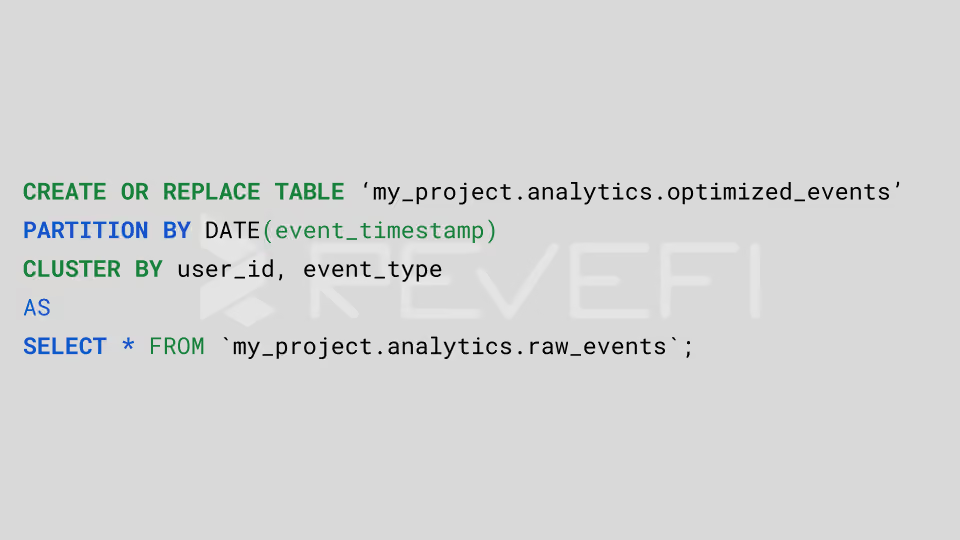
BigQuery charges users based on the bytes scanned by a query. If a user runs a SELECT * FROM massive_table WHERE date = '2026-01-01' on an unpartitioned table, BigQuery scans the entire dataset.
The AI DBA scans query execution patterns. If it notices a heavy reliance on specific filter predicates, it alters the schema programmatically or surfaces a DDL migration plan to convert the table into a Partitioned and Clustered Table.
Harnessing BigQuery ML (BQML) & Gemini in BigQuery
AI DBAs do not just operate alongside Google Cloud; they integrate deeply with Gemini in BigQuery and BigQuery ML (BQML).
- The AI DBA ingests structural telemetry from BigQuery's native system recommendations, applying them autonomously via IaC (Infrastructure as Code) pipelines.
- An AI DBA can instantiate an ARIMA_PLUS model inside BigQuery using BQML to forecast data growth and cloud expenditures for the upcoming quarter based on granular billing data.
Architectural and Feature Comparison
The approach an AI DBA takes must adapt to the underlying paradigm of each platform. The table below outlines how these optimization capabilities manifest across the three engines.
The Operational Mechanics: How Does the AI DBA Optimize Queries?
To truly appreciate the value of an AI DBA, let us trace its execution path through a common enterprise headache: a degraded, runaway ETL query.
Step 1: Anomaly Detection
The AI DBA's Observation Engine flags an alert: a scheduled reporting query that typically takes 4 minutes has been running for 45 minutes, consuming 12 times its standard compute allocation.
Step 2: Root Cause Analysis (RCA)
The AI DBA programmatically fetches the platform’s execution graph (e.g., Snowflake's Query Profile or Spark’s Directed Acyclic Graph - DAG). It evaluates the core bottlenecks:
- It detects a Cartesian Product (Cross Join) caused by a missing join condition in the SQL code.
- It flags significant Data Spilling to remote storage because the local memory footprint was exceeded.
Step 3: Mitigation Strategy
The AI DBA takes immediate, multi-tiered action:
- Immediate Cost Cap:
It terminates the runaway query to prevent further financial drain. - Code Correction:
Using an LLM fine-tuned on SQL syntax dialects, the AI DBA reviews the query text, identifies the unjoined table, and inserts the missing ON tableA.id = tableB.id clause. - Physical Layout Adjustments:
If the join was slow due to data distribution, it calculates whether creating an intermediate materialized view or altering the clustering structure would prevent future degradation.
Step 4: Verification and Deployment
The AI DBA sends a structured Git Pull Request to the analytics engineering repository containing the modified SQL code, complete with an explanation of why the change was made, the projected performance increase, and the estimated cost savings.
Security, Governance, and Compliance in the AI Era
Granting an AI system administrative control over enterprise data platforms introduces valid security concerns. Organizations must establish strict trust boundaries to safely operationalize an AI DBA.
Role-Based Access Control (RBAC) & Principle of Least Privilege
An AI DBA should never operate under a root or administrative superuser account (e.g., Snowflake’s ACCOUNTADMIN role). Instead, it must be granted dedicated, highly restricted service accounts.
- Metadata Read Privilege:
Access to read information schemas, query histories, and performance metrics. - Restricted Write Privilege:
Ability to execute specific optimization commands (ALTER WAREHOUSE, OPTIMIZE TABLE) while explicitly blocking access to the underlying customer data records (SELECT * FROM financial_transactions).
PII Masking and Data Privacy
When processing query logs through third-party LLMs or vector databases, there is a risk of data leakage if queries contain hardcoded literals with PII (e.g., WHERE email = 'user@domain.com'). Advanced AI DBAs incorporate a local Data Anonymization Pipeline. Before any SQL text leaves the enterprise network parameter, regex engines and lightweight local models substitute sensitive literals with abstract tokens (WHERE email = <ANONYMIZED_STRING>).
Auditability and Human-in-the-Loop (HITL)
For mature enterprise environments, the AI DBA operates in a hybrid Human-in-the-Loop configuration. Critical operations (such as deleting data, modifying table structures, or purchasing expensive reserved slot commitments) are routed through an approval workflow (e.g., Jira, ServiceNow, PagerDuty). The AI DBA generates a comprehensive impact statement, and execution remains paused until a human administrator clicks "Approve."
Conclusion: The Emergence of the Autonomous, Real-Time, and Self-Healing Data Stack
The transformation of database management from manual script execution to autonomous AI operation marks a major shift in enterprise data strategy. By taking over the tedious, computationally complex tasks of resource allocation, query optimization, and cost governance, the AI DBA changes data engineering from a reactive battle against infrastructure bottlenecks into a proactive driver of business logic.
As Snowflake, Databricks, and Google BigQuery continue to innovate with native AI layers like Cortex, Mosaic, and Gemini, the capabilities of the AI DBA will become deeper and more tightly integrated. Organizations that implement autonomous operations will enjoy lower cloud expenditures, lower query latencies, and a highly agile engineering team focused entirely on driving competitive value rather than managing system failures.
About Revefi’s AI DBA
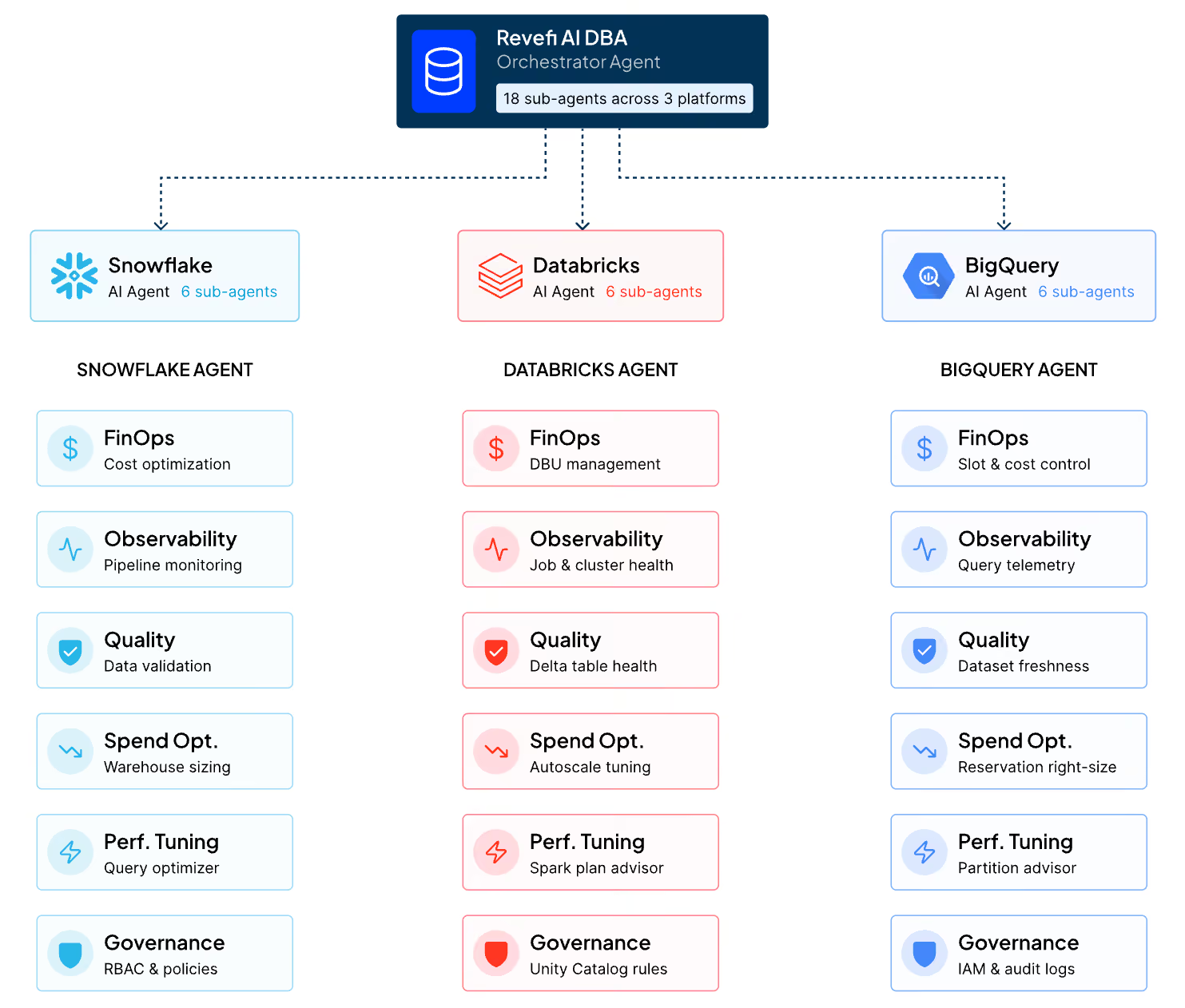
Revefi AI DBA is an autonomous Database Administrator platform that includes 18 specialized AI agents to manage cloud data platforms, specifically Snowflake, Databricks, and Google BigQuery. Running 24/7 with zero manual overhead, the platform is designed to reduce cloud data costs by 30% to 70%, achieve over 400% annual ROI, and deliver its first insights within an average of five minutes.
The architecture features a plug-and-play, read-only, metadata-only setup that requires no touch to deploy. The core framework assigns a dedicated team of six domain-expert sub-agents to each of the three supported platforms.
.avif)