
I am proud to share that Revefi has been recognized as a Representative Vendor in the 2026 Gartner Market Guide for Data Observability Tools for the second consecutive publication.
Why We Believe This Recognition Matters
In our opinion, inclusion as a Representative Vendor signals that Gartner has assessed the vendor as actively and meaningfully participating in the market and meets the bar for capability, relevance, and market presence.
We strongly feel that being recognized for the second consecutive year in a row tells us that what we’re building at Revefi is relevant not just with our customers, and with independent analysts who track this market closely.
The Data Observability Market Is at an Inflection Point
The market timing here is significant. “According to Gartner’s 2025 State of AI-ready Data Survey,1 53% of D&A or AI leaders said their organizations have already implemented data observability tools. In addition, 31% of respondents claimed they consider implementing the tools within 6-12 months, and 12% within 12-18 months, underscoring near-term momentum.” This is a market that has crossed the tipping point from early adoption to mainstream deployment.
Several forces are driving this urgency. AI and machine learning initiatives are moving from experimentation into production at scale and the quality of the data those models depend on is now a business-critical concern. Agentic AI is raising the stakes even further: autonomous systems need real-time, trusted data to make decisions, and any undetected pipeline failure can cascade directly into incorrect agent behavior.
At the same time, cloud data warehouse costs continue to climb. CFOs and engineering leaders alike are demanding visibility into where spend is going, which workloads are wasteful, and where optimization is possible. Data observability has expanded from a data quality discipline into a core operational and financial management capability.
Five Capability Categories of Data Observability: A Differentiator That Matters
Revefi supports all five observation categories which are identified in the image below.
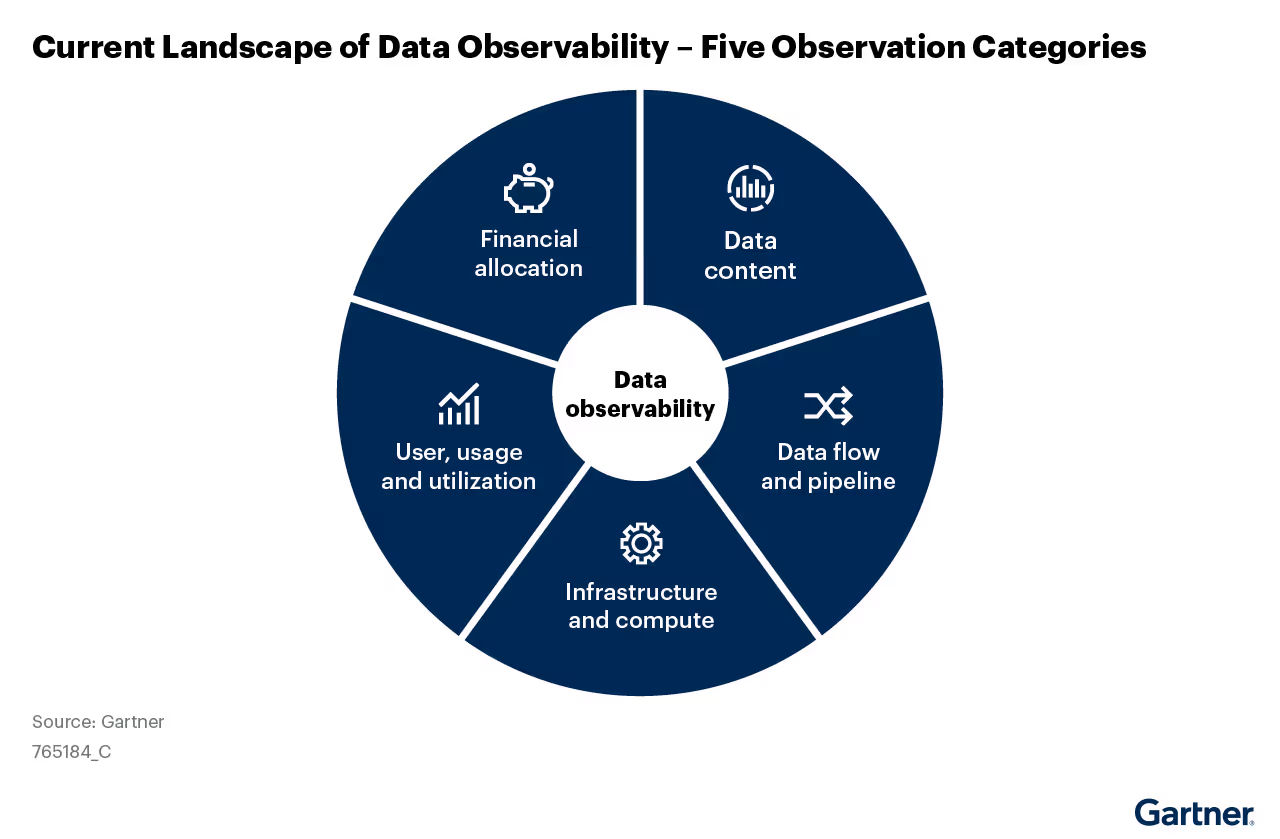
We believe that this recognition is due to a deliberate architectural decision we made early: that data observability should be a unified discipline, not a collection of siloed point tools. Fragmented observability leads to fragmented lineage, slower incident resolution, and missed correlations between data quality issues and their root causes, whether those root causes are in the data itself, in a failing pipeline job, in a resource-constrained query, or in a cost spike on a cloud warehouse.
Revefi brings all five categories together in a single platform from continuous monitoring of data freshness, volume, and schema health; real-time pipeline job tracking; end-to-end data lineage; infrastructure performance visibility across Snowflake, Databricks, BigQuery, and Redshift; and integrated cost optimization with performance optimization.
AI-Augmented Observability: Built for What’s Next
Gartner calls out AI-enabled observability as a capability rapidly proliferating across the market and rightly recommends buyers validate AI feature claims rigorously during piloting. We welcome that scrutiny.
Revefi leverages a multi-model AI architecture incorporating ML, Predictive AI and we give customers the option to use their own LLM of choice, OpenAI, Google Gemini, and Anthropic Claude to power automated anomaly detection, AI-assisted root cause analysis, predictive alerting and actionability across all five observation categories.
As the market shifts from reactive observability detecting failures after they happen towards predictive and proactive remediation, we have built capabilities that forecast data quality degradation, resource exhaustion, and cost anomalies and auto remediate them before they cause downstream impact.
Thank you, customers and teammates
We feel that this recognition reflects the trust our customers place in us every day. It is their pipelines, their data quality, and their cloud platforms that Revefi is responsible for observing and that responsibility drives everything we build. I’m grateful to our customers for their partnership, and to the entire Revefi team for continuing to push the boundaries of what is possible.
Girish Bhat
Gartner, Market Guide for Data Observability Tools, Melody Chien, Michael Simone, 23 February 2026
GARTNER is a trademark of Gartner, Inc. and/or its affiliates. Gartner does not endorse any company, vendor, product or service depicted in its publications, and does not advise technology users to select only those vendors with the highest ratings or other designation. Gartner publications consist of the opinions of Gartner’s business and technology insights organization and should not be construed as statements of fact. Gartner disclaims all warranties, expressed or implied, with respect to this publication, including any warranties of merchantability or fitness for a particular purpose.