Every roadmap slide for agentic AI ends in the same place, which is in the realm of “full autonomy.”
Fewer humans in the loop, faster resolution, lower cost per task. It's the destination everyone's building toward, and it's usually pitched as pure upside for AI agent cost optimization. The pitch skips a variable. Autonomy has a cost curve of its own, and that curve isn't flat and it doesn't slope neatly downward. Every increment of autonomy you hand an agent, more tools, more permissions, fewer checkpoints, carries a price. Past a certain point, that price rises faster than the labor it's replacing. Most teams are treating autonomy as a light switch, on or off, instead of a spectrum with a cost attached to every step along it.
Here's a framework for putting a shape to that spectrum, so you can find where your own workflows actually sit on it instead of assuming the answer is “as autonomous as possible.”
What Are the Levels of AI Agent Autonomy?
The auto industry's self-driving framework provides the clearest model for discussing AI agent autonomy, as the operational levels match almost perfectly.
Level zero involves a human completing the task with no agent support. Level one features an agent drafting suggestions while a human executes every action without granting the agent direct tool access. Level two allows the agent to execute actions, but requires human pre-approval and complete checkpointing at every step. Level three enables an agent to execute autonomously within a set scope, while humans review actions after completion through spot checks or exception logs. Level four consists of an agent executing and self-correcting without routine human intervention, limiting human involvement strictly to agent-flagged escalations.
Regarding the official driving taxonomy, the standard automotive scale includes a sixth level representing unrestricted autonomy across all conditions. This AI framework deliberately stops at level four. Here, level four represents full autonomy within a bounded workflow, which serves as the true ceiling for financial modeling. Unrestricted systems lack defined operational scopes for measuring costs, making them theoretical concepts rather than practical data points. This five-level model represents the complete operational spectrum.
Just like autonomous vehicles, most production AI agents currently operate at level two or level three. Roadmaps frequently assume level four as the target destination, a premise that requires careful evaluation before allocating quarterly budgets.
Why Isn't the AI Agent Cost Curve a Straight Line Down?
Total cost per completed task extends far beyond raw model expenses. It represents the combined sum of four distinct factors at every level of autonomy. These factors include compute expenses covering tokens, tool calls, and reasoning passes, error correction costs spanning retries, rollbacks, and manual fixes, oversight costs representing human time spent reviewing actions, and latency impacts that influence overall operational speed.
The common assumption suggests that this curve slopes continuously downward, where higher autonomy reduces human labor and lowers total expenses. While compute and oversight costs do decrease as autonomy grows, error correction costs rise sharply once an agent assumes complex judgment calls previously handled by personnel. This increase often occurs faster than expected, as a single faulty autonomous decision can trigger compound errors across multiple downstream tools before detection.
This dynamic creates a shallow U-shaped curve, or in severe cases, a trajectory that drops initially before climbing upward. The lowest cost point typically resides at level three rather than level four. Level three maintains low oversight expenses while preserving a safety net to catch cascading errors early. Level four often appears cheapest on pure model pricing alone, yet frequently becomes the most expensive option overall due to delayed, complex error recovery.
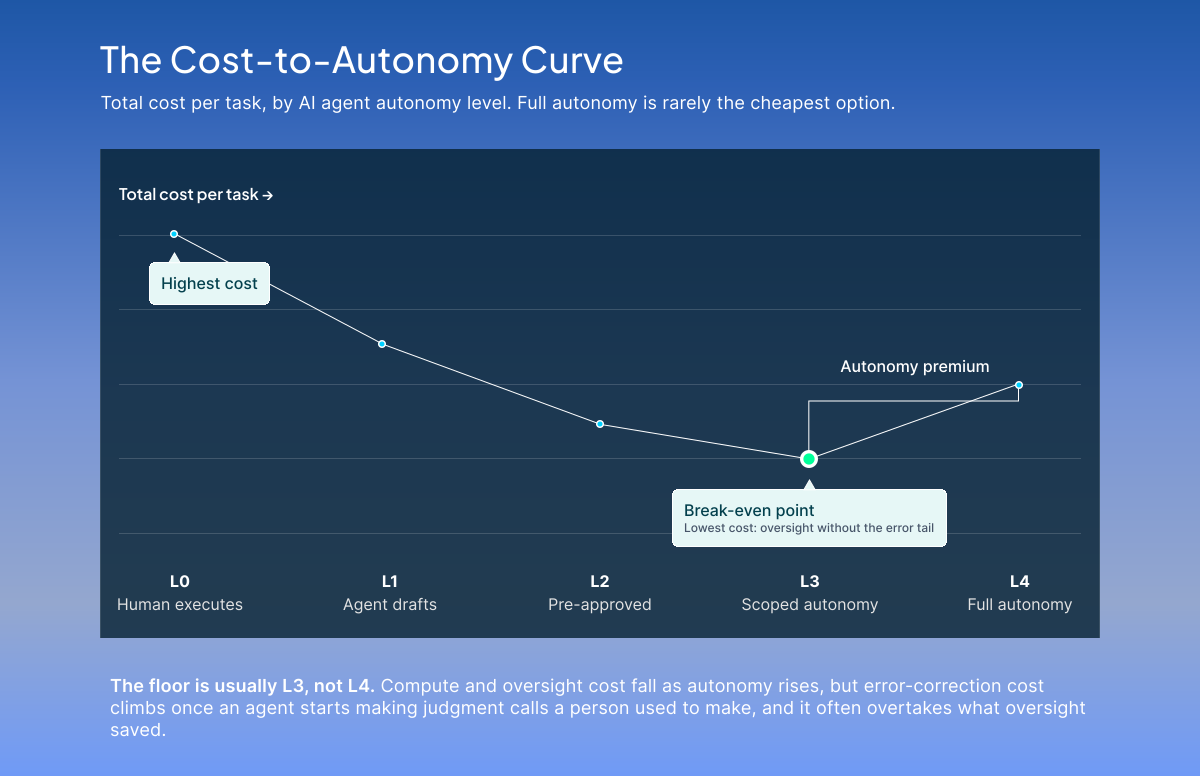
Full autonomy does not represent the lowest point on a cost curve, but rather a potential cost peak. The true target is the lowest cost point for a specific task, an outcome that must be measured rather than assumed.
What Is the Autonomy Premium in AI Agent Economics?
The autonomy premium represents the marginal cost of advancing one level up the autonomy scale. Moving a workflow from level three to level four creates an autonomy premium equal to the added error correction and escalation handling costs, minus the oversight costs removed by eliminating checkpoints. A negative premium justifies the shift to level four. A positive premium indicates an organization is paying for the appearance of automation rather than genuine economic benefit.
Most organizations fail to calculate this metric because they lack per-task cost and error tracking segmented by autonomy level. Without this visibility, the premium remains hidden, causing teams to pursue level four based on assumptions rather than data.
How Do You Find Your AI Agent's Break-Even Autonomy Point?
The break-even point is the specific autonomy level where the total cost per task reaches its lowest point for a given workflow. High-stakes, low-volume processes such as financial reconciliations or external client commitments usually reach their lowest cost point at level two or level three, where oversight acts as cheap insurance against severe errors. High-volume, low-stakes tasks such as routine data checks or internal ticket routing usually bottom out at level three or level four, where individual errors carry low costs and widespread human oversight becomes expensive.
Accurately plotting this curve requires four inputs, including task volume, per-task compute costs at each autonomy level, error rates at each level, and the precise cost of an individual error. Most teams currently struggle to track compute costs and error rates by level due to limitations in standard AI monitoring tools.
Why Doesn't Optimizing AI Agent Costs Lower Total Spend?
Identifying the break-even point lowers the cost per task, yet it does not necessarily reduce overall expenditure. This phenomenon reflects Jevons paradox, where increasing the efficiency of a resource drives up total consumption, often offsetting the initial cost savings. Teams that optimize a workflow's cost curve frequently respond by applying the agent to far more workflows, absorbing unit savings through increased volume.
Organizations must track cost per task and total spending as two separate metrics. A decreasing cost per task alongside an increasing total bill reflects expected operational expansion. When financial leaders inquire why total AI expenses rose following optimization efforts, they are tracking the correct growth trend through a macro lens rather than a unit efficiency metric.
The Takeaway
Full autonomy carries distinct costs and rarely delivers automatic savings. Every workflow has a measurable break-even point on the autonomy spectrum grounded in operational data. Identifying this point requires tracking per-task costs and error rates segmented by the specific level of autonomy granted to the agent.
Teams should close this observability gap and measure workflow costs across different autonomy levels before making major technical investments toward full automation.