
Most organizations already have an AI FinOps problem. Few of them would call it that, because the practice most of them are running isn't a practice, it's a reflex: someone in finance flags a spend spike, someone in engineering gets asked to explain it, and the answer usually amounts to a shrug and a promise to look into model routing next quarter.
That reflex is the starting point on a maturity curve, not a dead end. Cloud FinOps went through the same arc a decade ago, from nobody watching the bill to cost being a first-class input into every infrastructure decision. AI spend is following the same arc, faster, because the workloads are more volatile and the tooling is younger. Here's what the three stages actually look like, and what moving between them requires.
What Is AI FinOps?
AI FinOps involves managing AI expenditure with the exact same discipline typically used for cloud infrastructure costs. This approach requires clear visibility into spending drivers, strict team accountability, and an active feedback loop that converts financial data into continuous action instead of passive monthly reporting. The primary distinction between AI FinOps and traditional cloud FinOps centers on workload behavior. Cloud costs remain relatively predictable since virtual servers run steadily until shut down. In contrast, AI expenses fluctuate based on usage patterns that change with every model update, agentic workflow deployment, and prompt adjustment, creating a dynamic environment that is both harder to manage and far more critical to execute properly.
What Are the Three Stages of AI FinOps Maturity?
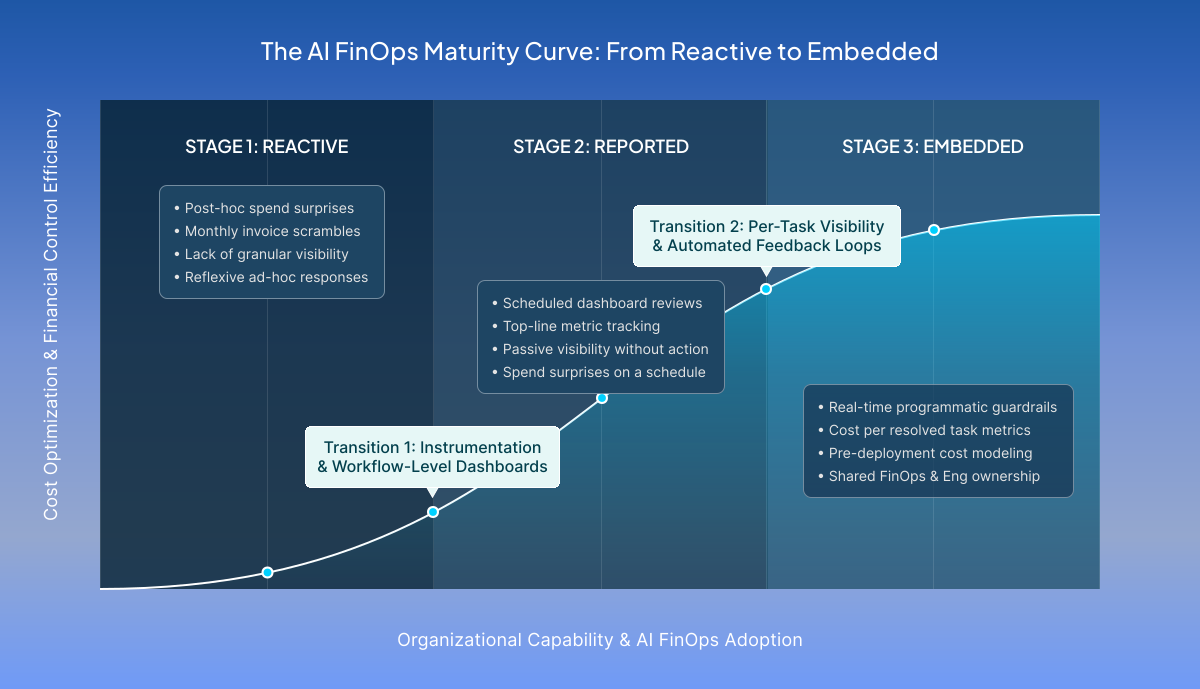
Reactive represents stage one. No one monitors AI expenses until the invoice arrives, which triggers a sudden panic and a chaotic rush to justify the cost afterward rather than a strategy to control future spending. The majority of companies running AI applications today operate within this phase, regardless of whether they acknowledge it.
Reported represents stage two. A dedicated dashboard exists, and team leaders review the metrics on a monthly or quarterly basis. While the figures are accurate, no feedback mechanism connects those insights to actual operational changes. Financial data becomes visible, yet visibility without active intervention offers little value beyond delivering the bad news on a predictable schedule rather than without warning.
Embedded represents stage three. Expense considerations actively guide engineering choices before projects launch instead of serving as a post-project audit. Any team pitching a new agentic workflow projects its estimated cost per task prior to deployment. Decisions to upgrade models rely on cost per resolved task rather than performance benchmarks alone. Automated safeguards intercept unexpected cost spikes instantly instead of during end of month reviews. At this point, AI FinOps transitions from an external financial review into a collaborative practice embedded directly within development teams.
Note: There are several emerging maturity frameworks for FinOps for AI or AI FinOps. We propose a simpler, easy to track framework here.
Who Actually Owns AI FinOps Today?
This situation reveals the core structural issue beneath the maturity curve. Cloud FinOps maintained a straightforward ownership model where platform or infrastructure teams controlled expenditures and took direct action. AI spending completely ignores those traditional operational boundaries.
A single agentic workflow might interact with a model vendor, a data pipeline, a vector database, and multiple internal APIs, distributing financial accountability across several domains. In reality, data and platform engineering teams inherit AI FinOps duties by default, simply due to their proximity to the underlying pipelines rather than true operational alignment. This arrangement creates a significant organizational mismatch that requires clear acknowledgment. Companies must assign explicit ownership over AI financial accountability, an essential role that currently remains unassigned in most organizations.
How Do You Move From Reactive to Embedded?
The transition from reactive to reported relies primarily on proper instrumentation. Organizations must deliver accurate dashboards to key stakeholders, breaking down expenditures by specific workflow and team instead of relying on a solitary top-line figure. Moving from reported to embedded proves far more challenging, as it demands two capabilities that few companies currently possess. Teams need per-task cost visibility to evaluate individual workflow expenses before scaling operations. They also require a functional feedback loop that uses cost data to drive operational choices rather than just populating monthly meeting slides.
Companies that attempt to leap directly from reactive habits to embedded practices frequently hit a wall, because teams cannot build effective guardrails around metrics they cannot reliably track. Creating a clear reporting dashboard is not a wasted effort, it is the essential first step toward long-term success.
The Takeaway
If your organization's response to an AI spend surprise is still “let's dig into the bill and figure out what happened,” you're in the reactive stage, and that's a normal place to start, not a failure. The work is building toward embedded, where cost is a known input before a workflow ships rather than a mystery to solve after it scales. That requires per-task visibility most AI stacks don't have out of the box, which is the actual bottleneck standing between most teams and the maturity level they say they want to reach.