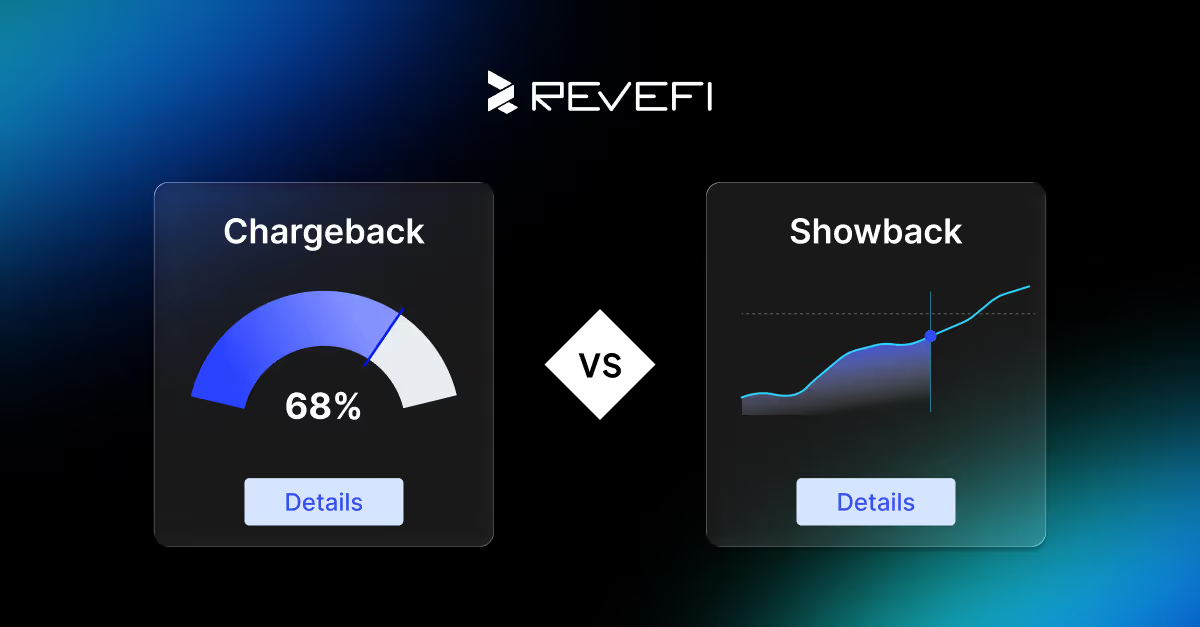
Here's a conversation that plays out in almost every scaling data org: finance wants to know which team owns the Snowflake bill, and engineering says it's shared infrastructure. Nobody's lying. But without a proper cost allocation model, that conversation never reaches a resolution. Understanding showback vs chargeback is how you break that cycle. Whether you're on Snowflake, Databricks, or BigQuery, choosing the right allocation framework is what separates teams that manage their cloud spend from teams that are managed by it.
Managing these cloud costs requires the right infrastructure visibility. Revefi provides a structured approach to FinOps for Data. Rather than structurally benefiting from higher compute usage like native tools often do, Revefi focuses entirely on operational efficiency. The platform consistently helps organizations identify up to a 60% average cost savings. Read on to explore which allocation model fits your data ecosystem.
Key takeaways
- Deciding between showback vs chargeback directly impacts your organizational culture and how data teams manage their cloud budgets.
- Implementing chargeback and showback requires clear workload tagging, robust metadata governance, and intelligent observability platforms.
- Complex consumption pricing models in Snowflake, Databricks, and BigQuery make manual cost allocation difficult and heavily prone to error.
- Revefi automates data cost usage and optimization, delivering a 10x improvement in overall operational efficiency.
- Organizations generally succeed by starting with a showback model to build awareness before transitioning to strict chargeback enforcement.
What is showback and chargeback in cloud cost management?
Showback definition
Showback is a financial reporting model that displays the exact cloud costs incurred by specific departments. In this framework, the central FinOps team provides detailed billing visibility without deducting funds from departmental budgets. This approach builds financial awareness, fiscal responsibility, and encourages data teams and engineers to optimize their Snowflake, Databricks, and BigQuery usage voluntarily.
Chargeback definition
Chargeback takes financial accountability a step further by actively billing individual business units for their specific cloud consumption. When a department runs expensive analytical queries, those exact costs are deducted directly from their internal profit and loss statements. This strict enforcement model ensures that teams treat data infrastructure costs with absolute financial seriousness.
Why cost allocation matters in Snowflake, Databricks, and BigQuery
Without cost allocation, there is no way to link infrastructure spending to business value. Modern data warehouses like Snowflake, Databricks, and BigQuery use dynamic consumption pricing, which means an organization cannot determine ROI for its data products without proper allocation. Mastering chargeback and showback lets you connect every credit consumed to the team or product that generated it.
How Snowflake, Databricks, and BigQuery consumption pricing creates allocation challenges
Shared warehouse usage
Snowflake allows multiple distinct user groups to share the exact same active compute warehouse simultaneously. Similarly, Databricks and BigQuery use shared compute clusters and slot pools. While this shared architecture is excellent for performance, it makes dividing the resulting compute bill inherently difficult without advanced observability.
Cross-team query workloads
Complex data pipelines often serve multiple downstream departments at once. When a central engineering team processes a massive dataset used by marketing and finance in Snowflake, Databricks, or BigQuery, allocating that specific query cost becomes subjective. Traditional billing dashboards simply cannot parse out these nuanced cross-team workloads effectively.
Idle and burst compute patterns
Data environments frequently experience unpredictable spikes in usage followed by long periods of idle compute time. Assigning the financial penalty for an idle warehouse to a specific team is challenging when multiple users triggered the initial auto-resume. These burst patterns obscure true cost ownership and complicate financial reporting.
Showback vs chargeback: key differences enterprises should know
Accountability vs enforcement
The core difference between showback vs chargeback lies in how an organization drives financial behavior. Showback relies entirely on visibility to encourage data teams and engineers to optimize their code. Chargeback enforces operational efficiency by making data costs a tangible line item on a department manager's actual budget.
Cultural and organizational impact
Chargeback introduced too early creates friction. Developers hesitate to run necessary analytical workloads in Snowflake, Databricks, or BigQuery when they know every query hits the team budget directly. Showback generally fosters a more collaborative culture, easing teams into broader FinOps concepts before enforcement begins.
Implementation complexity
Building a showback report only requires gathering accurate usage data and presenting it cleanly to stakeholders. Chargeback requires deep integration with corporate accounting systems and precise workload attribution to prevent internal billing disputes. Deploying a true chargeback system demands significantly more upfront engineering coordination.
Examples
In a showback scenario, a marketing director receives a monthly dashboard showing their team consumed ten thousand dollars in compute credits. They review the data and ask their analysts to write more efficient queries. In a chargeback scenario, that exact ten thousand dollars is officially subtracted from the marketing department's allocated quarterly budget.
Benefits of showback for Snowflake, Databricks, and BigQuery environments
Cost visibility without friction
Adopting a showback model provides immediate spend visibility across Snowflake, Databricks, and BigQuery without threatening departmental funding. Teams gain the critical insights needed to understand how their daily query habits impact the overall corporate invoice. This friction-free environment is conducive to early-stage cost optimization efforts.
Encouraging responsible usage
When engineers can clearly see the dollar value attached to their specific data pipelines, natural accountability follows. Developers inherently want to write efficient code and will proactively seek ways to lower their reported usage. This organic drive for efficiency frequently results in significant cloud spend reduction across the enterprise.
Easier FinOps adoption
Transitioning an entire engineering department to a FinOps mindset takes considerable time and executive patience. Showback acts as the right foundation for advanced chargeback strategies. It allows your FinOps leaders to perfect their tagging and attribution models before any real money changes hands internally.
When chargeback is the better model for Snowflake, Databricks, and BigQuery
Mature FinOps organizations
Once an organization establishes robust workload tagging and accurate metadata tracking, moving to chargeback becomes logical. Mature FinOps teams possess the granular data required to justify internal billing without facing constant engineering disputes. At this stage, chargeback becomes a largely automated financial process.
Budget ownership requirements
In decentralized enterprises, product teams must operate as independent financial units. Chargeback ensures that these distinct business units are fully responsible for the Snowflake, Databricks, or BigQuery infrastructure costs they generate. This strict alignment guarantees that data products only scale if they remain financially viable.
Strong governance environments
Heavily regulated industries or companies with rigid profit margins require absolute certainty regarding their operational expenditures. Chargeback provides the strongest possible governance over cloud data costs, eliminating the risk of unmonitored budget bloat. It forces engineering teams to justify their architectural choices rigorously.
Can showback and chargeback work together?
Phased FinOps maturity approach
The most successful modern data teams use both models sequentially. They deploy showback during their initial FinOps rollout to establish baselines and clean up obvious architectural inefficiencies. Once the culture adapts and the cost attribution data is verified, leadership formally transitions the enterprise to a strict chargeback model. You can explore the FinOps maturity framework for a broader view of how this progression typically unfolds.
Hybrid allocation strategies
Some organizations blend these concepts into a highly effective hybrid strategy. Core IT might cover the baseline costs of shared Snowflake, Databricks, or BigQuery ingestion using a showback model for visibility. Meanwhile, specific departments are placed on a chargeback model exclusively for their ad-hoc analytical queries.
Organizational readiness signals
You know your team is ready to transition when engineers routinely check their daily cost dashboards without prompting. Another clear signal is when internal disputes over shared warehouse attribution drop to zero. These cultural indicators prove your foundational data governance is strong enough to support an official chargeback rollout.
Tools that enable Snowflake, Databricks, and BigQuery showback and chargeback
Native Snowflake, Databricks, and BigQuery cost attribution
Cloud platforms provide native features like object tagging and query history views to help teams categorize their consumption. While these built-in tools offer a solid starting point, they require extensive manual effort to maintain accurately. Relying strictly on native tools often leads to gaps in attribution during cross-team workloads.
FinOps and observability platforms
To achieve true precision, teams must implement specialized cloud observability platforms. While traditional IT departments might evaluate general tools for advanced chargeback and showback, modern data ecosystems require deep, query-level analysis. Dedicated data observability platforms connect the exact SQL code executed directly to the financial cost incurred.
Automated allocation and anomaly detection
Modern platforms eliminate the manual spreadsheet work traditionally associated with financial reporting. By deploying AI agents, FinOps leaders can automate the categorization of every single compute credit burned across Snowflake, Databricks, and BigQuery. This intelligent automation also surfaces unexpected spikes in usage instantly.
How Revefi improves Snowflake, Databricks, and BigQuery cost allocation and accountability
Granular workload attribution
Revefi automatically maps your entire cloud architecture, attributing specific compute costs directly to users, roles, and exact queries. This deep visibility removes the guesswork from shared warehouse and cluster usage entirely. FinOps leaders receive accurate data to power their chosen chargeback and showback frameworks.
Automated chargeback modeling
Revefi eliminates the manual burden of calculating cross-team query costs across Snowflake, Databricks, and BigQuery. The platform automatically separates shared infrastructure expenses from dedicated departmental usage based on intelligent rules. This ensures your internal financial reporting remains consistently accurate and undisputed.
Cost optimization insights and governance
Beyond simple reporting, Revefi proactively drives spend reduction. The platform identifies idle warehouses, over-provisioned clusters, and inefficient queries automatically. By surfacing these actionable insights, Revefi helps organizations achieve up to 70 to 90% cost savings, ensuring absolute budget health.
Best practices for implementing showback and chargeback successfully
Define allocation policies early
Before presenting any financial data, establish exactly how shared resources in Snowflake, Databricks, and BigQuery will be divided. Document clear rules regarding who pays for failed queries, idle compute time, and central data ingestion pipelines. Clear policies prevent confusion and ensure high confidence in your reporting accuracy.
Align finance and engineering teams
Successful cost allocation requires continuous collaboration between your developers and your accounting department. Ensure both groups understand the specific metrics and terminology used in your monthly reports. For deeper insights into fostering this collaboration, review the CFOs Guide To Managing Cloud Data Costs.
Continuously monitor and refine
Cloud data environments are dynamic, meaning your allocation strategies must evolve alongside your architecture. Regularly review your workload tagging accuracy and update your financial models as new business units onboard. To explore actionable ways to keep your environment efficient, read these nine Techniques to Optimize Snowflake Costs 2026.