Article
News
June 1, 2026

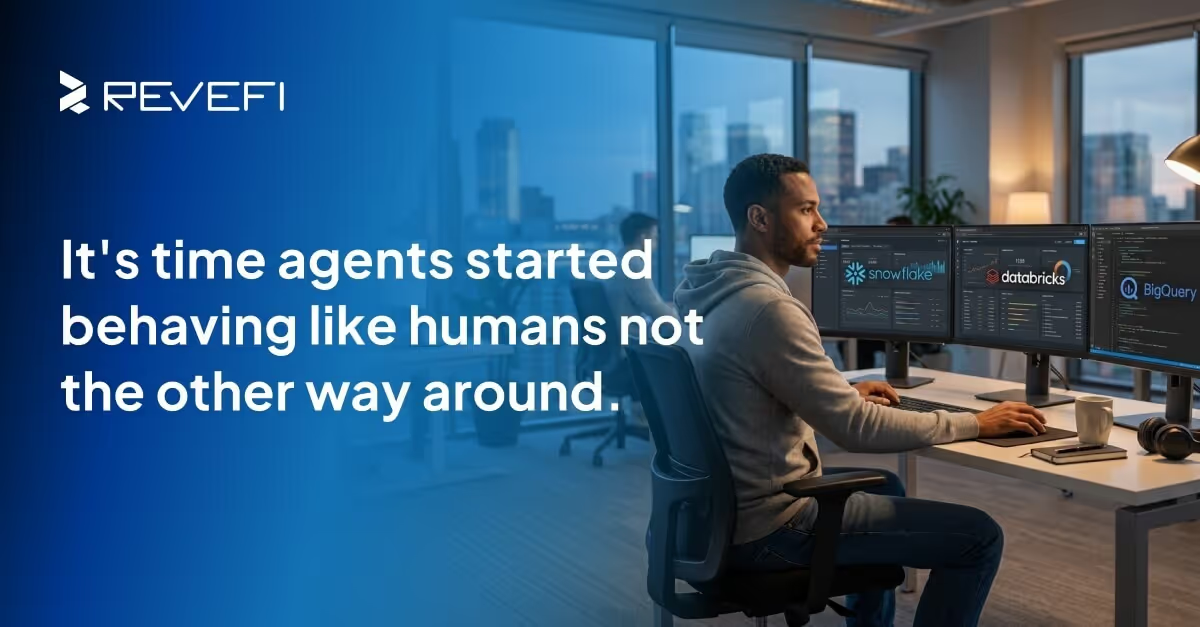
It's time agents started behaving like humans not the other way around.

Sanjay Agrawal
CEO, Co-founder of Revefi

We've spent years coaching people to be more systematic, more process-driven, more... agentic. The irony? The most powerful thing we can do with AI now is make it more human.

There's a narrative I keep hearing at every data summit, every boardroom check-in, every all-hands: "How do we get our team to think more like machines?" Faster. Tireless. Rule-following. Optimized.

We've been asking the wrong question entirely.

The real shift isn't humans becoming more agentic. It's agents learning to behave the way the best humans do — with context, judgment, proactive care, and a sense of consequence. Not just automation. Genuine intelligence that mirrors how a great DBA, a sharp data engineer, a meticulous FinOps analyst actually shows up to work.

"The question isn't whether AI can run the query. It's whether AI understands why that query matters to the business."

The old model: humans becoming machines

For a long time, "data operations excellence" meant building humans who could operate at machine speed. Create runbooks. Follow protocols. Respond to alerts at 2am. Document every decision so another human could reproduce it deterministically.

This is exhausting, expensive, and it turns out not where human talent is best spent. The best data people don't excel because they're systematic. They excel because they know when to break the system.

Old model: humans acting like agentsNew model: agents acting like humans
Follow the runbookUnderstand intent behind the runbook
React to alertsAnticipate before the alert fires
Optimize when told toOptimize continuously, without being asked
Escalate to a senior engineerCarry the judgment of a senior engineer
Document findings after the factProvide insight in real time, always

What "human behavior" actually means for an AI agent

When I say agents should behave like humans, I don't mean they should be slower or make more mistakes. I mean they should carry the qualities that make great humans irreplaceable:

👁️Situational awareness

Reading what's happening across the entire environment, not just the metric that crossed a threshold.

🕒Never off the clock

The 3am warehouse spike doesn't wait for business hours. A great agent is always watching, always ready.

🧠Judgment, not just rules

Knowing that the expensive query is expensive for a reason, and that right-sizing it requires understanding the workload, not just the cost.

🛡️Ownership of outcomes

Acting, not just recommending. Fixing the cluster configuration instead of filing a ticket about it.

Meet RADEN — the agent that never sleeps

Revefi AI Agent

RADEN

A unique AI agent that autonomously monitors your entire enterprise data estate across Snowflake, Databricks, BigQuery, and Redshift, not as a passive observer, but as a principal actor. RADEN detects, decides, and delivers. It embodies the instincts of a senior DBA who has seen every failure pattern, a FinOps engineer who knows where every dollar leaks, and a data engineer who never leaves things half-done.

Warehouse right-sizingQuery rewritingIdle resource detectionCluster optimizationCost anomaly detectionSLA monitoringData observabilityAutonomous remediation

What makes RADEN different from a dashboard that fires alerts? It closes the loop. When it detects a performance bottleneck, it doesn't ask for your attention; it acts. When it sees a query pattern bleeding cost, it rewrites it. When a warehouse is sitting idle, it suspends it. The human insight is baked in. The human effort is not required.

This isn't theoretical. Here's what it looks like in practice.

60%

Snowflake spend cut at Verisk, while usage grew 50%

665K+

Monitors created automatically across 130,000 tables

10x

Operational efficiency gains across enterprise deployments

Customer story · Verisk · Global CDO Louis DiModugno

"Revefi's autonomous AI Agent helped slash Snowflake spend by 60%, even as usage increased by 50% across key warehouses."

7 trillion rows. 130,000 tables. Zero human input required to build the monitoring layer.

The real question for data leaders

If your agents are just doing what you tell them, you're still running a human-bottlenecked operation. The whole point is that the agent should be anticipating what needs to happen before you've had your morning coffee.

Gartner named Revefi a 2025 Cool Vendor precisely because of this philosophy. It is lightweight, AI-native with  more automation, rather than complex platforms that still require human orchestration at every step.

The modern data stack is growing up. And growing up means moving past the model where AI is a fancy search bar, and into a model where AI is a full participant — one that shows up with the instincts, the context, and the accountability of someone who genuinely owns the outcome.

Stop asking your team to think like machines.Build machines that think like your best people.That's the only version of the future worth building.

Sanjay Agrawal
CEO, Co-founder of Revefi
Sanjay founded Revefi using his deep expertise in databases, AI insights, and scalable systems. Sanjay also has multiple awards in data engineering to his name. With over 20 years of experience, Sanjay boasts a rich background in organizational leadership and a deep expertise in enterprise systems, covering high-performance databases, analytics, learning, and data recommendation systems. He was instrumental in shaping ThoughtSpot from its inception. Sanjay has spent many years at Microsoft Research working on topics related to automated SQL optimization and worked on various innovations at Google.
Blog FAQs
What does it mean for an AI agent to "act like a human" in data operations?
It means the agent carries the qualities that make experienced data professionals valuable: situational awareness across the full data estate, judgment about why a workload behaves the way it does, anticipation before alerts fire, and ownership of outcomes through direct action. The agent isn't slower or more error-prone than a rules-based system. It just operates the way a senior DBA or FinOps engineer would, with context and consequence rather than rote rule-following.
How is RADEN different from a traditional data observability or monitoring tool?
Traditional observability tools surface problems and route them to humans through dashboards and alerts. RADEN closes the loop. When it detects a bottleneck, it doesn't file a ticket, it acts. It rewrites inefficient queries, right-sizes warehouses, suspends idle resources, and remediates anomalies autonomously across Snowflake, Databricks, BigQuery, and Redshift. The human insight is baked into how it decides. The human effort to execute is not required.
What measurable outcomes have enterprises seen from autonomous AI agents like RADEN?
Verisk cut Snowflake spend by 60% while usage grew 50%, with RADEN automatically creating 665K+ monitors across 130,000 tables and 7 trillion rows, zero human input required to build the monitoring layer. Across other enterprise deployments, customers have reported up to 10x operational efficiency gains. These results come from agents that continuously optimize rather than waiting to be told what to fix.
Will autonomous AI agents replace data engineering and FinOps teams?
No. The point isn't to replace data people, it's to stop using them as runbook executors. Autonomous agents handle the repetitive, machine-speed work like right-sizing, query rewriting, idle detection, and anomaly remediation, so data engineers and FinOps analysts can focus on the work that actually requires human judgment: architecture decisions, stakeholder alignment, and high-leverage business problems. The team gets smaller in its operational footprint and larger in its strategic impact.
How does an autonomous AI agent decide when to act versus when to escalate?
A well-built agent operates the way a senior engineer does: it understands the intent behind a workload, not just the metric that crossed a threshold. RADEN evaluates whether an expensive query is expensive for a reason, whether a warehouse spike reflects legitimate business activity, and whether a configuration change is safe to apply. Routine optimizations execute autonomously. Decisions that fall outside its confidence envelope or have material business consequence are surfaced to the right human with full context attached.