


The performance of a modern data warehouse like Snowflake is fundamentally contingent on the integrity of its query logic. While Data Engineers dedicate significant effort to optimizing ETL/ELT pipelines, a subtle, yet deeply costly, issue often persists: Bad Joins.
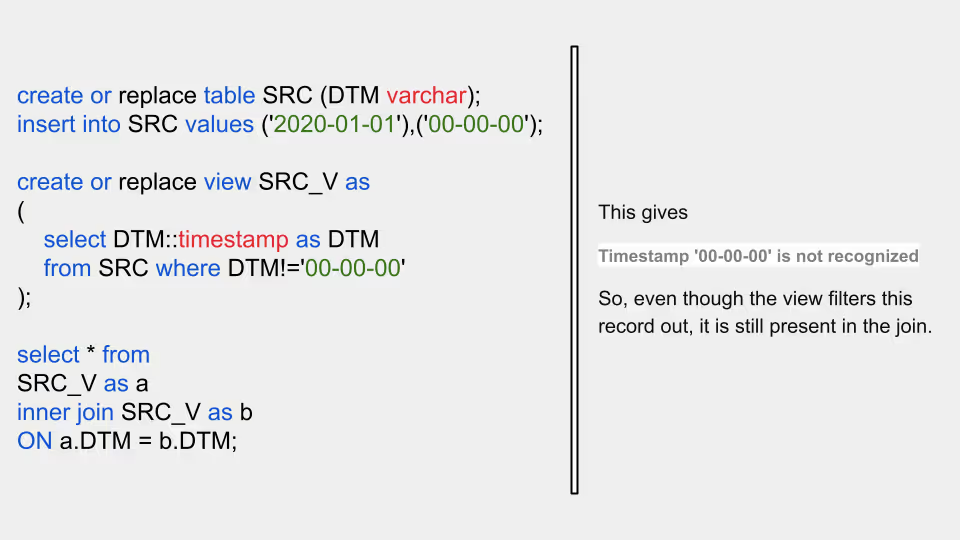
A "Bad Join" is not merely a simple SQL error; it is a critical technical pattern (often emerging unintentionally due to evolving schema, data drift, or flawed logic) that results in non-linear resource consumption, compromised data accuracy, and excessive Snowflake credit usage.
This post will provide a deep dive into the specific technical nature of this problem in the Snowflake environment and demonstrate how Revefi’s AI Agent (RADEN), delivers the only autonomous solution to identify, diagnose, and resolve these costly joins at scale.
The Technical Cost of Bad Joins
In Snowflake, the impact of a bad join extends far beyond minor latency, often manifesting as high-cost, high-latency phenomena that destabilize FinOps efforts.
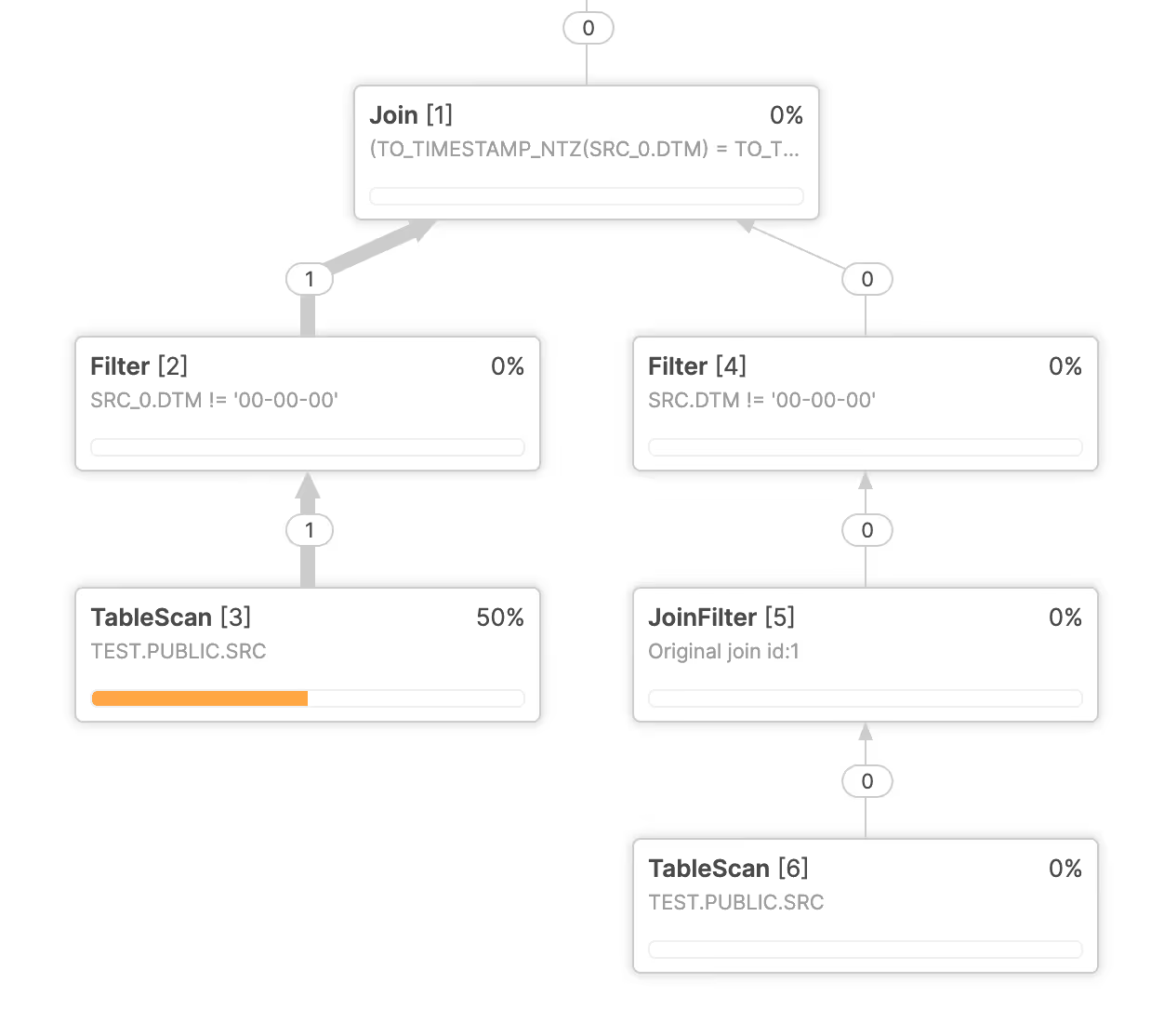
1. Exponential Data Sprawl (The Cartesian Product)
The most catastrophic scenario occurs when a query accidentally results in a Cartesian Product, combining every row from one table with every row from another due to a missing or faulty join condition. A query involving tables with $N$ and $M$ rows instantly generates $N \times M$ intermediate rows, leading to:
- Massive Data Sprawl: Immediate, exponential growth in data processed.
- Compute Exhaustion: The Virtual Warehouse (VW) is forced to allocate significant compute resources to process the unnecessary intermediate results, driving up credit usage instantaneously.
2. Spilling and Cloud Service Layer Strain
When a join operation drastically exceeds the memory limits of the allotted VW size, Snowflake must resort to disk spilling(writing intermediate query results to local disk or remote storage). This process:
- Drastically Slowers Query Execution: Disk I/O is orders of magnitude slower than memory operations.
- Increases Cloud Services Utilization: The metadata and compilation load on the Cloud Services layer increases, potentially pushing up overall operational costs and affecting multi-tenancy performance.
3. Data Skew and Parallelism Degradation
While Snowflake is highly optimized for parallel processing, bad joins can exacerbate data skew. If a join condition disproportionately clusters data onto a few partitions within the VW, these specific compute nodes become bottlenecks. The query's total runtime is then dictated by the slowest node, degrading the efficiency of parallel execution and leading to frustratingly inconsistent query performance.
Why Manual Detection Fails in Scalable Environments
For organizations running hundreds of data pipelines, detecting bad joins is practically impossible using traditional methods or manual inspection:
- Non-Scalable Review: Manually reviewing the QUERY_HISTORY view for anomalies or high byte counts is not scalable across the hundreds of queries and dozens of VWs running daily.
- Hidden Complexity: Bad joins are often buried deep within complex, multi-stage joins within stored procedures or materialized view definitions, making them subtly wrong but massively expensive.
- Reactive vs. Proactive: Traditional alerting typically only flags a query after it has already consumed an exorbitant amount of credits. Effective FinOps requires a preventative, predictive approach.
Revefi’s Autonomous Solution: RADEN to the Rescue
Revefi shifts the paradigm from reactive monitoring to Zero-Touch Data Observability utilizing its proprietary AI Agent, RADEN (Revefi Autonomous Data Engineering Navigator).
5.1. Autonomous Discovery and Query Fingerprinting
Revefi continuously ingests and analyzes comprehensive execution metadata and query profiles from Snowflake (via system views). RADEN then autonomously performs:
- Query Fingerprinting: It classifies and segments queries based on their execution structure, immediately identifying patterns indicative of join defects, such as a highly disproportionate ratio of Data Scanned to Data Returned or excessive partition scans for a given join operation.
- Cost Anomaly Detection: RADEN establishes an automatic baseline for the typical cost and runtime of every job. It proactively pinpoints any deviation where the Cost Per Row or the resource utilization of a specific join stage deviates significantly, the unmistakable signature of a bad join.
5.2. Root-Cause Analysis and Actionable Remediation
Revefi provides a deep dive into the root cause, transforming a simple alert into an immediate resolution. Unlike generic monitoring, RADEN functions as an AI Data Engineer by delivering specific, actionable fix recommendations:
Conclusion: Turning FinOps into DataOps
Bad Joins are a critical operational failure that masquerades as a cost problem. In the era of petabyte-scale data, relying on manual inspection or delayed, reactive alerting is a significant liability to both budget and data reliability.
Revefi's platform, with its specialized AI Agent, provides the necessary evolution to autonomous data operations by automatically observing data, detecting the root cause of failures and cost overruns like bad joins, and providing the precise, actionable intelligence needed for rapid resolution.
